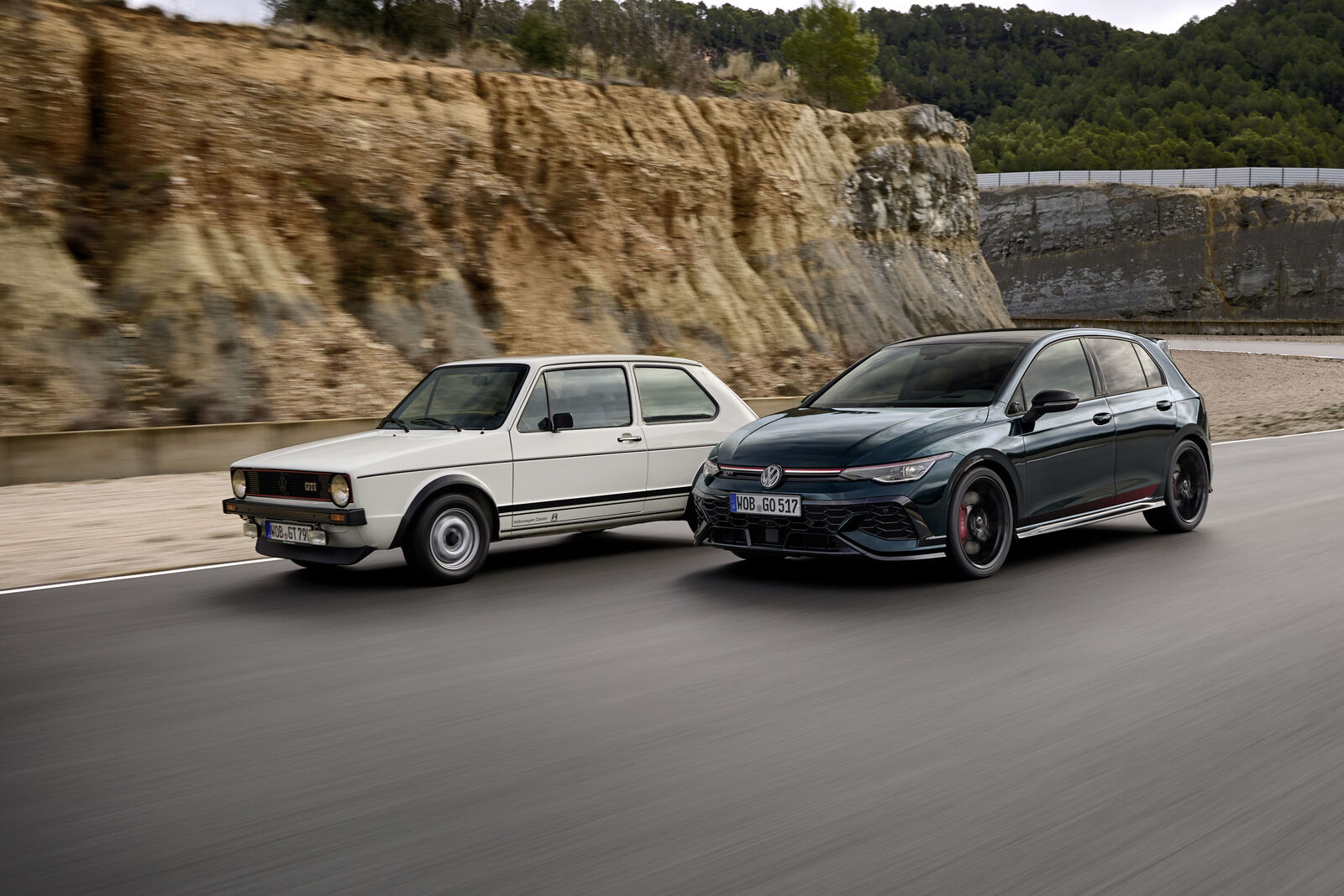
Golf I GTI – 1976 to 1983
The original. The history of the Golf GTI begins at the Nürburgring. There, in the summer of 1975, a prototype of the sports car was used as a pace car, and the spectators were taken aback at how this Volkswagen could be so incredibly fast. GOLF lettering was on the doors, but the name GTI was still a secret. But the later characteristic black stripes above the side members were already there. A few weeks later, Volkswagen revealed the secret behind the model and unveiled a concept vehicle of the Golf GTI with a top speed of 182 km/h in a world premiere at the International Motor Show (IAA) in Frankfurt. Demand was enormous – everyone wanted this compact sports car. As early as June 1976, the 110 PS Golf GTI made its debut first in Germany, then around the globe. 5,000 units of the special series were initially planned. But things turned out quite differently: the 5,000 units of the first Golf GTI series eventually ended up being 461,690 – and the product line was crowned by the ‘Golf GTI special model’ with 112 PS, which became known as the ‘Pirelli GTI’.
Golf II GTI – 1984 to 1991
First evolutionary stage. From 1984, the second Golf GTI seamlessly continued the philosophy of the sporty compact car. In the eighth year of GTI history, the typical insignia of the sports car already enjoyed cult status: black wheel arch extensions, black front spoiler, black-framed rear window, black headliner and red frame in the radiator grille. A perfect match: the Mars Red and later Tornado Red GTI paintwork. With 112 PS, the new GTI was initially as powerful as the predecessor. Those who opted for a version with one of the first catalytic converters from 1985 had five PS less at their disposal. However, already in 1986, Volkswagen added more GTI power with a technical innovation: a new 16V engine. In the version without regulated catalytic converter, the four-valve engine developed 139 PS and achieved a top speed of 208 km/h. And even the Golf GTI 16V with regulated catalytic converter, and in this case with 129 PS, travelled at 200 km/h on German motorways from 1987. ABS was available as an option for the first time. In 1990, a ‘G-Lader’ scroll-type supercharger boosted the output in the Golf GTI G60 to 160 PS and the top speed to 216 km/h. In November 1990, the GTI broke the barrier of one million units built and became the most successful compact sports car in the world.
Golf III GTI – 1991 to 1997
Pure understatement. It was characterised by visually restrained dynamics: the Golf III GTI presented in 1991. Only the black wheel arch and side member trims, black spoilers, the Le Mans or Monte Carlo alloy wheels and a twin-pipe exhaust system made it recognisable as a GTI. The sports chassis lowered the body by a modest amount. The headlights were a stylistically distinctive feature. They were a new interpretation of the twin headlights of the first and second Golf GTI generations. This time, however, all light functions were located in a common headlight housing – one of numerous aerodynamic measures that made the third GTI more efficient and faster. These measures also included the roof spoiler, which reduced air turbulence in the rear area. In terms of power, the Golf III GTI started out with 115 PS, which its 2.0-litre two-valve four-cylinder engine again sent towards the front axle. Thanks to the sophisticated aerodynamics, this output made it possible to achieve a top speed of 196 km/h. The new Golf GTI 16V with 150 PS made its debut in 1993. Top speed: 215 km/h. It accelerated from 0 to 100 km/h in just 8.7 seconds and was therefore just as fast as the earlier Golf II GTI G60 with 10 PS more. In 1996, a turbodiesel with 110 PS enriched the GTI range. The Golf ‘20 Years of GTI’ was also launched in 1996 – the first anniversary model in GTI history.
Golf IV GTI – 1998 to 2003
A style icon. The Golf IV is quite rightly still considered a style icon to this day. Hartmut Warkuß, the long-standing Head of Design of the Volkswagen Group, shaped the precise and puristic design DNA that led Volkswagen models into the future in terms of style. At the same time, the fourth Golf and, with it, the fourth GTI took a huge technical leap forward. This was also reflected in the exceptional quality of the body and interior. High-tech was also present in the area of the new GTI engines: The customer could choose between a 1.8-litre turbocharged petrol engine with 150 PS and a 2.3-litre five-cylinder engine, also with 150 PS. With both engines, the Golf IV GTI had a top speed of 218 km/h. In 2000, the output of the V5 engine increased to 170 PS and the top speed thus to 224 km/h. In addition, a turbodiesel was available again, which initially developed 110 PS, then 115, 130 and 150 PS. However, the crowning glory of the Golf IV GTI in 2001 was the 180 PS turbocharged petrol engine in the ‘25 Years of the GTI’ special model – a turning point in the history of the GTI.
Golf V GTI – 2004 to 2008
Pure GTI. In September 2004, Volkswagen presented the fifth Golf GTI at the Paris Motor Show, a car that once again realised the GTI idea in a significantly sportier way. Characteristics: a sharper look with distinctive radiator grille in a new black honeycomb look with red GTI surround, black front spoiler, also black side members, a roof spoiler in the vehicle colour, chrome-plated twin tailpipes, new sports seats, high-end chassis and a new 200 PS turbocharged engine. This delivered a real punch: the 2.0-litre four-cylinder engine accelerated the GTI with manual gearbox to 100 km/h in 7.2 seconds; with the direct shift gearbox (DSG), the time was just 6.9 seconds. The GTI reached its top speed only at 235 km/h. In 2006, Volkswagen launched the 230 PS Golf GTI Edition 30 on the market to mark the 30th birthday of the cult athlete. Its 230 PS are quickly explained: there was one more PS for each GTI year compared with the 200 PS version. Visually striking: matt black 18-inch Detroit alloy wheels. Light-coloured 18-inch aluminium wheels in a cross-spoke design (Rockingham) were available as an alternative. The front spoiler, rear apron and side members were painted in the vehicle colour, while the tail light clusters were darkened. Exclusive partial leather sports seats with centre panels in the classic Interlagos check pattern enhanced the interior. The equipment also included a manual or DSG gear knob in the form of a golf ball. The fastest GTI to date reached 245 km/h and accelerated to 100 km/h in just 6.8 seconds.
Golf VI GTI – 2009 to 2012
Perfected spirit. The sixth generation of the Golf GTI made its debut in 2009. None other than racing legend Hans-Joachim Stuck was in charge of honing the vehicle’s setup. With the new generation, a GTI with a top speed of 240 km/h followed, offering plenty of fun with its 210 PS turbocharged engine, which also allowed it to complete the sprint from standstill to 100 km/h in 6.9 seconds. This GTI featured a sound generator and a new exhaust system concept (with one tailpipe each on the left and right), delivering audible dynamic performance. For the first time, the new GTI also featured the XDS electronic differential lock as standard. Thanks to XDS, the handling was much more precise and neutral. In 2011, the most powerful GTI to date with 235 PS followed as the ‘Edition 35’. The Golf GTI was also available for the first time as a Cabriolet model from 2012.
Golf VII GTI – 2013 to 2020
Record-breaking GTI. In 2013, Volkswagen launched the seventh Golf GTI in two variants: a 220 PS version and a GTI Performance version with 230 PS. On this basis, the Golf GTI Clubsport – a special model for the 40th anniversary of the Golf GTI – followed at the beginning of 2016 with an output of 265 PS, and temporarily even 290 PS with the boost function. It was also the first Golf GTI to break the six-second mark at 5.9 seconds and had top speed of 250 km/h. In the same year, the new Golf GTI Clubsport S with its 310 PS broke down the boundaries to motorsport: in the spring, Volkswagen works driver Benjamin Leuchter broke the record at the time for front-wheel drive vehicles around the Nürburgring Nordschleife at the wheel of the Clubsport S with a top speed of 265 km/h, posting a lap time of 07:49:21 minutes – what a way to celebrate the Golf GTI’s 40th anniversary. In 2017, the ‘normal’ Golf GTI and Golf GTI Performance also received more power: the new standard version now produced 230 PS, and the new Golf GTI Performance 245 PS. In 2019, a further highlight of the seventh GTI generation followed: the 290 PS Golf GTI TCR – a tribute to the successful 350 PS car from the international TCR racing series.
Golf VIII GTI – since 2020
High-performance GTI. The Golf VIII GTI made its debut in 2020. Its 2.0-litre turbocharged engine develops an output of 180 kW (245 PS) and a torque of up to 370 Nm. For the first time, a newly developed vehicle dynamics manager is used in the Golf GTI, which has a top speed of 250 km/h and is always shifted by means of a seven-speed DSG. It coordinates the XDS+ enhanced electronic differential lock and the lateral dynamics components of the optional DCC electronic damping control and the front axle differential lock. The sharpened driving dynamics properties guarantee a completely new and pure driving experience. To mark the 45th anniversary of the GTI, the 221 kW (300 PS) Clubsport 45 was launched in 2021. In 2024, Volkswagen enhanced the Golf GTI with a hardware and software update, including new lighting, Infotainment and operating systems. The output of the Golf GTI increased from 180 kW (245 PS) to 195 kW (265 PS). The power of the Golf GTI Clubsport remained the same at 221 kW (300 PS). The performance of the further refined chassis with standard details such as an electronically controlled front differential lock is outstanding in all models. As a new milestone in 50 years of GTI history, Volkswagen then presented the new Golf GTI EDITION 50 at the 24-hour race at the Nürburgring in 2025. In the anniversary year 2026, this is now followed by the official market launch of the most powerful Golf GTI to date, delivering 239 kW (325 PS).