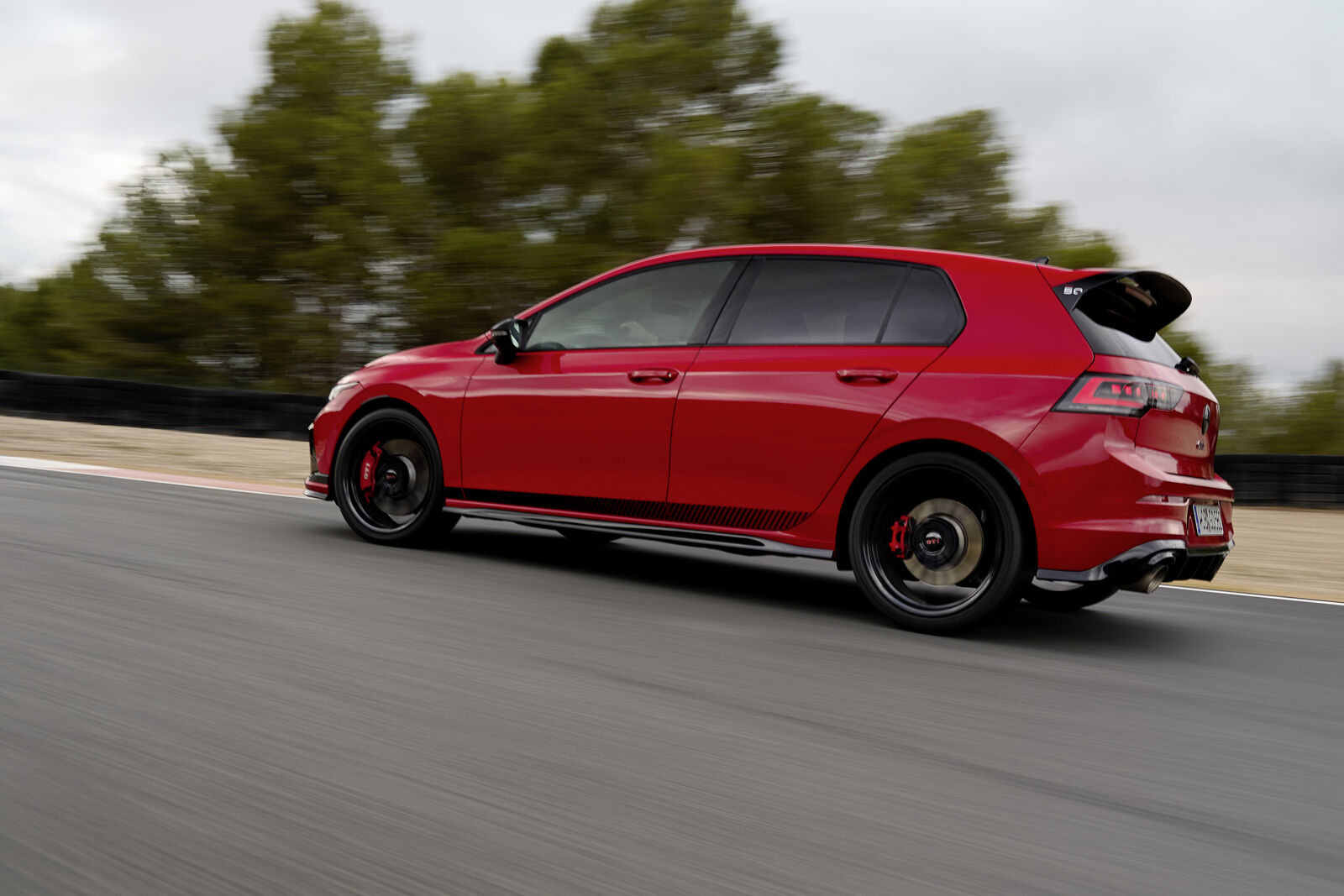
Performance-enhanced Clubsport engine. It is the most powerful engine Volkswagen has ever installed in a standard Golf GTI: the 1,984 cm3 TSI is a four-cylinder turbo direct injection engine from the EA888 LK3 evo4 engine series. evo4 stands for the latest evolutionary stage of the responsive petrol engine model. With an output of 239 kW (325 PS), it outperforms the engine of the current Golf GTI Clubsport (221 kW/300 PS) by a further 18 kW (25 PS). The increase in power compared to the Golf GTI Clubsport, on which the engine of the Golf GTI EDITION 50 is based, was achieved by implementing measures within the engine. The engine provides its maximum torque of 420 Nm between a low 2,000 rpm and a high 5,400 rpm – and thus over a very wide engine speed plateau. Compared to the Golf GTI Clubsport, it increased by 20 Nm and compared to the classic Golf GTI by 50 Nm. As the maximum torque in the Golf GTI EDITION 50 is available in many engine speed ranges, the compact sports car is extremely agile. However, not in an excessive manner but – typical of the GTI – a remarkably confident one. The drive power is transferred to the front axle via a seven-speed direct shift gearbox and a front differential lock configured specifically for the Golf GTI EDITION 50.
High dynamics, low consumption. From a standstill, the new Golf GTI EDITION 50 only takes 5.3 seconds to accelerate to 100 km/h. For comparison: the Golf GTI with 195 kW (265 PS) accelerates to 100 km/h in 5.9 seconds, the 221 kW (300 PS) Golf GTI Clubsport in 5.6 seconds. The maximum speed is 270 km/h (electronically limited). Compared to the two other Golf GTI versions, the anniversary model stands out with 20 km/h more. The high levels of dynamism are offset by a combined WLTP consumption of 7.9 to 7.6 l/100 km. The efficiency of the direct injection system is increased by innovative technical details such as a water-cooled exhaust gas recirculation to the turbocharger integrated in the cylinder head. Thanks to a fully electronic coolant regulator unit, the GTI features very effective thermal management with a short warm-up phase. The resultant reduction in friction losses could reduce fuel consumption.