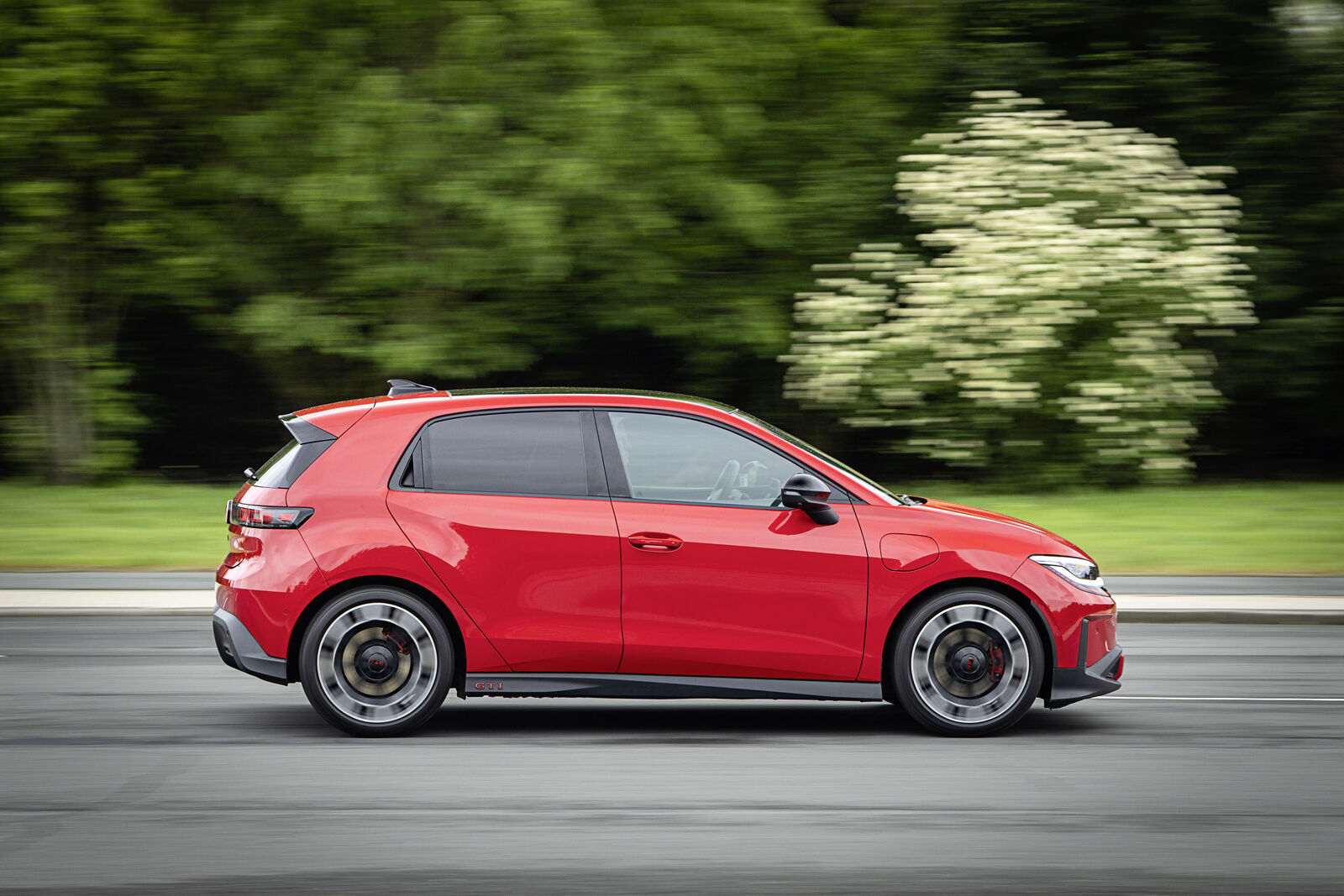
GTI clarity. Timeless, balanced proportions, powerful. This was already the case with the first Golf GTI in 1976 and was just as true for the first Polo GTI in 2006. These characteristics have remained unchanged up to the present day and will continue to be honoured in the future. The latest example demonstrates this very well: the new ID. Polo GTI. In terms of body layout, the first electric model in the GTI’s 50-year history applies the new Volkswagen Pure Positive design language, creating a compact sports car stand with a particularly clear and powerful stance atop its up to 19-inch alloy wheels. The result is an extremely crisp GTI design with proportions reminiscent of a 1976 Golf GTI, albeit one that has been transported into the future. So, how is this achieved? Through the stylish DNA shared by both Volkswagens, despite them being 50 years apart: Both the first GTI and the latest GTI are characterised by a straight window line, a long wheelbase compared with the overall length and correspondingly short and thus crisp body overhangs. The new GTI is 4,096 mm long. The wheelbase between the wheel rims is 2,599 mm. Measured from the wheel hubs, the body overhang is only 780 mm long at the front and just 717 mm at the rear. The ID. Polo GTI is 1,513 mm tall and 1,816 mm wide. Its dimensions are thus on a par with the Polo GTI from the combustion engine world, which is being phased out in 2026. However, the electric ID. Polo offers significantly more space in the interior and luggage compartment – this is where the optimum use of space permitted by the modular electric drive (MEB+) platform comes into its own.
GTI front end. The iconic red stripe is the most well-known hallmark GTI feature. It extends below the new ID. Polo GTI’s characteristic LED light strip across the entire width of the GTI. Integrated into the red stripe on the left: the 3D GTI logo. The standard-equipment LED light strip, the illuminated VW badge and the new IQ.LIGHT LED matrix headlights, which are standard in the GTI, are positioned above this as a horizontal bar. The lighting system is the most powerful across all ID. models. Below the line is the bumper, which blends particularly well with the red GTI line and the red GTI logo in the relaunched GTI colour Tornado Red (first introduced in 1986 with the Golf GTI II). A narrow LED strip is arranged vertically on each of the outer sides of the bumper, emphasising the width of the ID. Polo GTI and at the same time lending the front end additional visual stability. At the very bottom is the air intake for air conditioning of the interior and battery system – black and designed in the classic GTI honeycomb pattern. Two red-painted vertical elements are incorporated here on the outside in each case. Their design is reminiscent of the towing eyes from motorsport. Last but not least, a front spoiler in the style of a motor sports splitter ensures that the GTI hugs the road perfectly, both visually and aerodynamically.
GTI side section. A stabilising design element is the straight window shoulder – its line extends from the front end over the A-pillar to the start of the C-pillar. Positive tension is created in combination with the feature line running parallel underneath and only rising above the rear wheel arch, the clear door surfaces and the sturdy side member – all classic features for a Volkswagen and a GTI. The side members are covered with black plastic elements at the bottom to enhance the vehicle’s aerodynamics and give it a low-slung, sporty appearance on the road in combination with the large wheels. A fine detail: the red GTI lettering integrated into the rear of the side member. For purely stylistic reasons, the side member itself is extended forwards into the lower end of the bumper and backwards as far as the GTI’s striking diffuser. Probably the most quintessential Volkswagen feature found in the silhouette is the C-pillar inspired by the first Golf from 1974. The visual stability of the C-pillar literally flows into the body and rear wheel arches, giving this area a particularly powerful appearance.
GTI wheels. The ID. Polo GTI’s 19-inch alloy wheels develop their own visual dynamics. Two wheels are available: the standard Cape Town wheel and the optional Wörthersee wheel. Both alloy wheels are typical examples of the consistent enhancement of the GTI DNA. The design of the standard Cape Town wheel rim is a new interpretation of the GTI Denver rim, which was developed for the Golf V and enjoys cult status among GTI fans. The optional Wörthersee wheel rim can be seen as a tribute to the GTI meet on Lake Wörthersee in Austria and thus as a sign of appreciation for GTI fans. It is also interesting to note that the prototype of this wheel was featured on the ID. Concept GTI in 2023 – the concept vehicle of the ID. Polo GTI. The wheel rim developed specifically for the electric GTI model features eight double spokes and a striking outer area with eight semi-circular holes; the inside surfaces of the rims are black, while the edges of the eight semi-circular holes are polished to a high-gloss finish. One thing is certain: specific wheel rim designs – starting with the legendary Pirelli alloy wheel of the Golf GTI I – have always been a defining feature of a GTI. Like the Pirelli and Denver wheels, the 19-inch alloy wheels on the ID. Polo GTI could also have the potential to gain cult status.
GTI rear. Unlike the less powerful models in the new product line, the ID. Polo GTI has a roof spoiler that is divided in the middle as a visually striking feature. Under the spoiler, the rear window extends far into the C-pillars, thus emphasising the width of the ID. Polo GTI and at the same time ensuring a good view to the rear from the inside. In the level below it is the glass-covered LED horizontal bar of the tail light clusters which, together with the horizontal area painted in the vehicle colour underneath, creates a superior, sportily crisp and at the same time likeable effect. The ID. Polo GTI is equipped as standard with the IQ.LIGHT version of the tail light clusters, each of which has two outer, almost rectangular LED elements in 3D design. As a result, they appear to float freely in the GTI rear end (known as the 3D diamond effect). The transverse strips in the rear light crossbar and the VW logo are also illuminated on the GTI. The two-part rear diffuser is black and has a powerful design. To the rear, it protrudes beyond the body and thus protects the painted surfaces of the bumper. At the side, the diffuser transitions into the side members at the very bottom along a notional line. As a result of the synergy between the specific roof spoiler, the bumper – which also has a specific design at the sides – and the diffuser used only on this model, the new ID. Polo GTI is immediately recognisable as a GTI even without the three legendary letters. Nevertheless, it is reassuring that this Polo still bears the red GTI emblem under the VW logo.
Six colours for the GTI. The classic colours of all GTIs include Silver, Black, Red and White. This spectrum will also be available for the new ID. Polo GTI. The colour range will be supplemented by two blue shades. The six colours are called Tornado Red solid, Candy White solid, Oyster Silver metallic, Celestial Blue metallic, Magnetic Grey metallic and Grenadilla Black metallic.