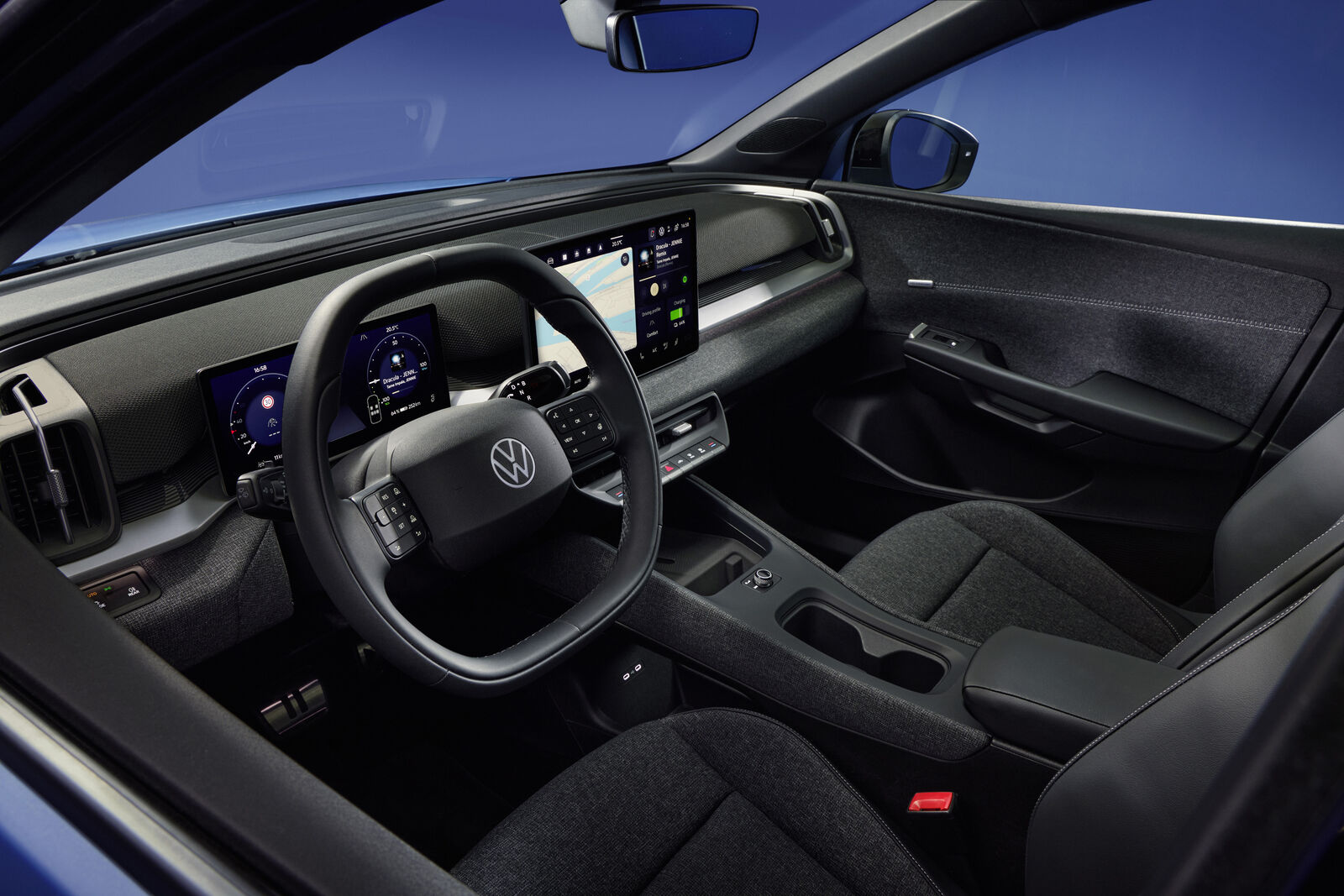
Pure and positive on the inside too. The Volkswagen Pure Positive design language also influences the design of the interior. It is the incredible clarity, the perfection in every detail and the quality of the materials used that create an interior that transforms every minute on board into a feel-good experience – whether in the hustle and bustle of the big city or on longer trips. Up until now, this demand had only ever been met by larger and more expensive vehicles.
Volkswagen Head of Design Andreas Mindt: “That’s why – for new Volkswagens like the ID. Cross, but also the ID. Polo or T-Roc – we have created an interior that feels like a friend from the very first encounter. Clear physical buttons foster a feeling of stability and confidence, warm-looking materials give it a friendly aura, while lovable details like the new retro instrument views allow Volkswagen’s hallmark charisma to shine through as the secret sauce. In the case of the ID. Cross, all this is combined with excellent economy of space. And it is precisely this combination that creates an interior that invites passengers to enjoy their time on board.”
Stability, likeability and secret sauce. Pure Positive is based on the three cornerstones of Volkswagen design: Stability, likeability and secret sauce. the clarity and logic of the horizontal dashboard architecture reflect the aspect of stability. Every detail is clear and coherent, and every physical touchpoint is positioned exactly where you expect it. This intuitive operating concept creates a familiar Volkswagen environment on board the ID. Cross. The warm and friendly interior design embodies the likeability factor. Details such as the fabric-covered dash panel, elegant controls like the tactile, metallic outer edge on the audio controls in the centre console, and the pleasant feel of all buttons, controls, handles and surfaces create an inviting and friendly atmosphere. Features such as the interactive ID.Light, which now extends into the doors, or the digital instruments’ retro view inspired by the Golf I (facelift generation) add the secret sauce – in this case technical details that display information in an innovative way or appeal on an emotional level.
Clearly structured cockpit landscape. The new ID.Cross has a horizontal dashboard land-scape. The Digital Cockpit Pro and the infotainment display are arranged on one visual axis. The Digital Cockpit Pro measures 26.0 cm (10.25 inches) across the diagonal and features crystal-clear graphics. If the driver uses the View button on the steering wheel to activate the retro view, a dash of secret sauce is added as the instruments transform into the style of instrument found in the later Golf I models. In this case, there is a classic speedometer on the left and a tachometer on the right. In the ID. Cross, however, it does not display the speed of the engine, but rather the energy output or energy consumption of the drive (as a powermeter). Of course, other modern functions like the Dynamic Road Sign Display have also been integrated into the 1980s-inspired layout. The infotainment system’s touch display, which is located in the centre of the dashboard, measures 32.77 cm (12.9 inches) across the diameter and is as large as a premium tablet – and the quality of the graphics is just as precise. The display is also easy to reach for the front passenger.
New multifunction steering wheel. The multifunction steering wheel with its clearly arranged button panels has also been completely redesigned. The cruise control system or, depending on the equipment, Adaptive Cruise Control and Connected Travel Assist are combined in the button group to the left of the airbag and horn. This group also contains the volume control.
To the right of the airbag is the group of buttons for controlling the Digital Cockpit, activating the voice control and the button for the steering wheel heating (heating function can also be retroactivated on demand). The steering wheel itself is flattened at the top and bottom (12 and 6 o‘clock). The steering-column levers for shifting gear and using the parking brake (right) and the turn signal, lighting and windscreen wiper functions (left) are located behind the steering wheel in an easily visible and accessible position. The central functions for the headlights and tail light clusters are also located to the left of the dashboard.
Buttons for climate control. The central climate control functions – temperature control, blowers, air conditioning on/off, automatic climate control mode, air recirculation, windscreen defroster, rear window heater – are integrated separately into a strip with easy-to-grip buttons in the centre console, while the hazard warning light switch is located in the centre. On the level below, there is the smartphone storage area with an equipment-dependent inductive charging option, two cup holders and the centre armrest with an integrated stowage compartment un-derneath. Between the smartphone storage area and cup holders, there is the rotary control for audio functions, which is equally easy to reach for the driver and front passenger, can be used to adjust the volume, but also to change songs and stations via the track function. The ID.Light (standard from Style and above) has undergone a major upgrade: For the first time, the interactive and intuitive light strip visible to the driver extends into the bottom of the windscreen, not just across the width of the dash panel, but now also into the front doors. However, the ergonomically designed door openers have been adapted from the new T-Roc. The four buttons for the electric windows and exterior mirror adjustment are also designed as a control panel in the driver’s door. However, attention to detail is not only reflected in the intuitive design of all elements and the quality of the materials, but also by equipment-dependent intricate details such as the elegant decorative seams in the door trim and the integration of small Volkswagen badges at the ends of these premium seams.
Quality without class limits. The new ID. Cross is also characterised by a quality of interior that is equivalent to the next class up. This impression is reinforced by details such as the robust and ergonomic door openers from the new T-Roc, the fabric-covered dashboard surface and optional features such as a high-end sound system from Harman Kardon and the 12-way electri-cally adjustable front seats with massage function, which were available in an SUV in this class for the first time. The space available in the rear also eliminates class boundaries. The same goes for the five-seater’s 475-litre luggage compartment. Built into the area under the variable luggage compartment floor is an XL storage area for transporting items like crates of drink. Just as practical is the 25-litre extra luggage compartment (frunk) under the bonnet, which can be used to store charging cables, for example.
Premium sound in the compact class. A quick look at the high-end sound system developed together with Harman Kardon demonstrates just how much effort has been put into the development of the individual technologies and modules: Volkswagen is raising the bar for the ID. Cross segment, creating a sound experience that was previously reserved for the mid-sized and upper classes. The hardware equipment sets new standards in the compact class: Ten speakers – two tweeters and two bass loudspeakers at the front, one centre speaker, two tweeters and two bass loudspeakers in the rear plus a subwoofer in the luggage compartment – ensure an exceptionally even sound experience throughout the ID. Crossv. Especially in the rear, this fosters a balanced soundscape without the need to increase the volume when children are listening to their music or audio content. A speaker in the middle of the dashboard, which we refer to as the centre speaker, also ensures that speech sounds clear and precise – ideal for podcasts and phone calls.
A superior 425 watts. With a system output of 425 watts, the sound system is perfectly dimensioned for the interior of the ID. Cross. The powerful subwoofer, integrated into a specially designed housing body in the luggage compartment, delivers a deep, controlled bass. The four rear loudspeakers are also actuated via their own, very powerful booster. This architectural concept guarantees a high level of transparency and stability of playback, even under a wide range of acoustic conditions.
Collaboration with sound experts. The system was developed in close cooperation with Harman Kardon. The focus was on precise differentiation and maximum acoustic transparency. The bass range is deliberately clear, focused and carefully tuned – powerful, but never dominant or exaggerated. The aim here was to create a “mature” listening experience that also impresses on longer journeys and is based on the standards of quality that audiophiles are used to. Volkswagen worked closely with the Fraunhofer Institute when it came to software programming and making vehicle-specific adjustments. A key outcome of this cooperation is something known as the Sonamic Panorama Algorithm. This technology releases individual sound sources from a classic stereo recording and distributes them around a U-shaped sound stage that surrounds the vehicle’s occupants. External elements of the soundstage are played back from the outer part of the rear, while signals placed in the centre remain acoustically stable in front of the listener. There is a noticeable improvement when it comes to the finer details, which are often concealed in conven-tional stereo playback. Particular attention was also paid to the consistent interaction between sound aesthetics and design. The acoustic properties of the interior surfaces were considered from the outset – from the exact specification of the loudspeaker grilles and their reflective behaviour to the fine-tuning of the system’s software fine-tuning depending on the surface materials used. Here, sound design and interior design blend seamlessly together. In the ID. Cross, Volkswagen consistently bridges the gap between acoustic performance and design quality – a holistic approach and a unique feature in this segment.