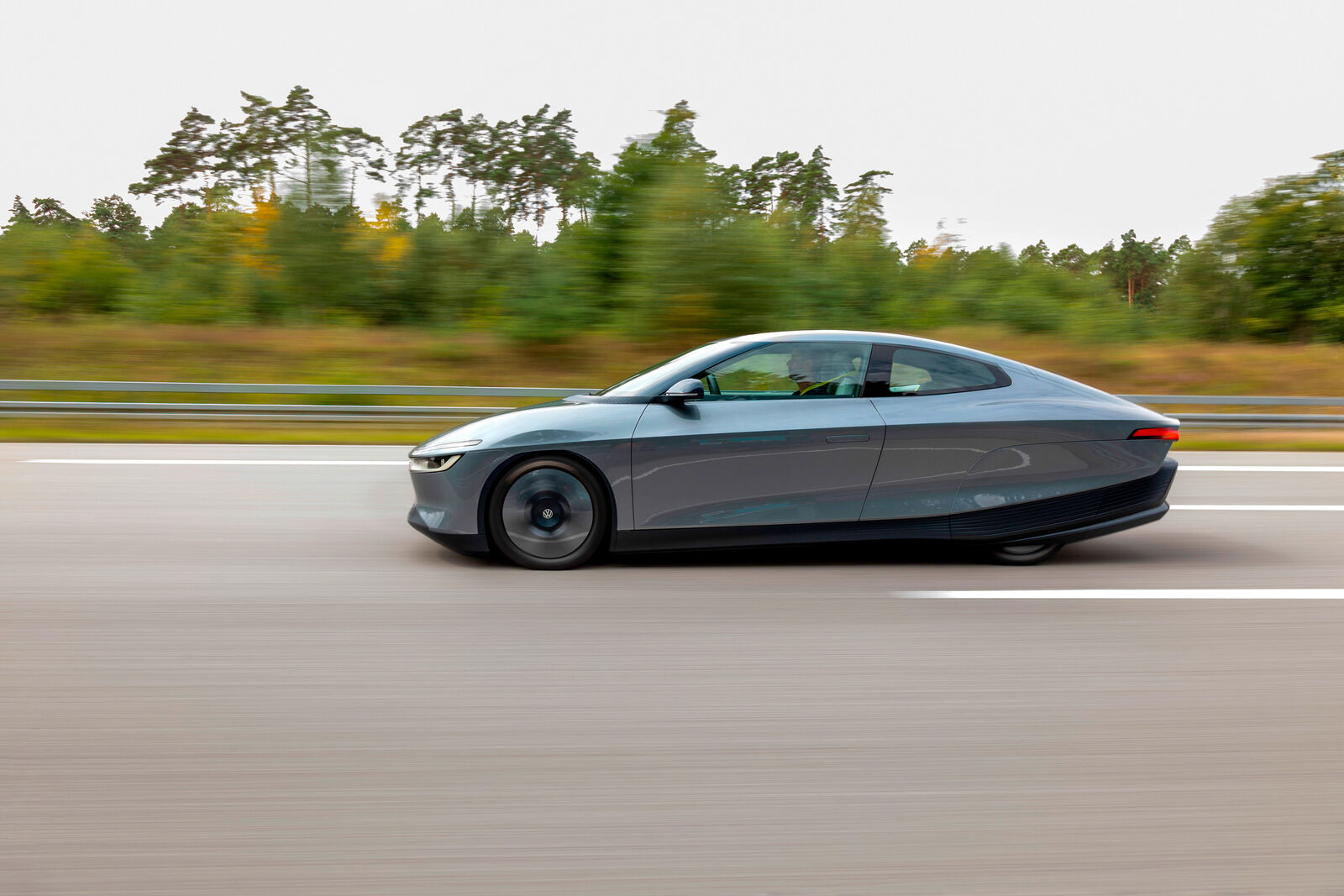
Drive layout and components. The Mission Efficiency has an electric front-wheel drive. The heart of this drive system is the APP290 electric drive motor – a permanently excited synchronous motor. The motor itself is small and very light at 75 kg – ideal for the concept car. A one-speed gearbox with adapted oil cooling and a longer ratio is flange-mounted to the motor housing. The 99 kW version (135 PS) of the electric motor is used in the Mission Efficiency – this is the current medium power output of the ID. Polo. The motor develops a maximum torque of 264 Nm and a maximum speed of 13,000 rpm and is coupled to the 54.9 kWh high-voltage battery (net).
New pulse inverter as the coordinator. The pulse inverter, which was first introduced with the ID. Polo and is now also used in the Mission Efficiency, coordinates the power and torque development as well as the recuperation of the drive. These power electronics also convert the direct current (DC) stored in the battery into the alternating current (AC) needed by the electric drive motor. The new pulse inverter is a module developed by Volkswagen that increases efficiency and thus reduces consumption. Other components of the drive integrated compactly in the front end include the AC and DC charging sockets, the battery charger and an electric A/C compressor as an important component of the thermal management system.
Natural refrigerant. The Mission Efficiency has a heat pump integrated into the air conditioning system on board. This reduces the energy consumption of the heating system at cold outside temperatures. The air conditioning system and heat pump are operated with the natural refrigerant R744. Volkswagen is the only automotive manufacturer in the world to have already developed a heat pump with a natural refrigerant for use in series production and is thus systematically paving the way for the use of PFAS-free refrigerants.
Efficient unified cell. The flat lithium-ion battery system of the Mission Efficiency – the unified cell – is located in the vehicle floor between the front and rear axles. It is a new development by the Volkswagen Group and its subsidiary PowerCo, which is already offered in series production in the MEB+ with front-wheel drive. The new battery system uses cell-to-pack technology, where the cells are combined directly into a battery pack without the intermediate step via module housings. Three of these battery packs form the energy storage unit in the battery system. In parallel to this, its housing reinforces the body structure of the record-breaking vehicle. The battery used on board the Mission Efficiency has an energy content of 54.9 kWh (net) – a nickel-manganese-cobalt (NMC) variant with a very high energy density. The AC charging capacity is 11 kW. DC quick-charging stations were used to charge the battery with a capacity of up to 105 kW – though only one charge was required on the record-breaking journey from Wolfsburg to Vienna. The battery used in the Mission Efficiency corresponds to the standard battery in the new ID. Polo; only the maximum usable energy quantity was increased by 2.9 kWhby software adaptation.