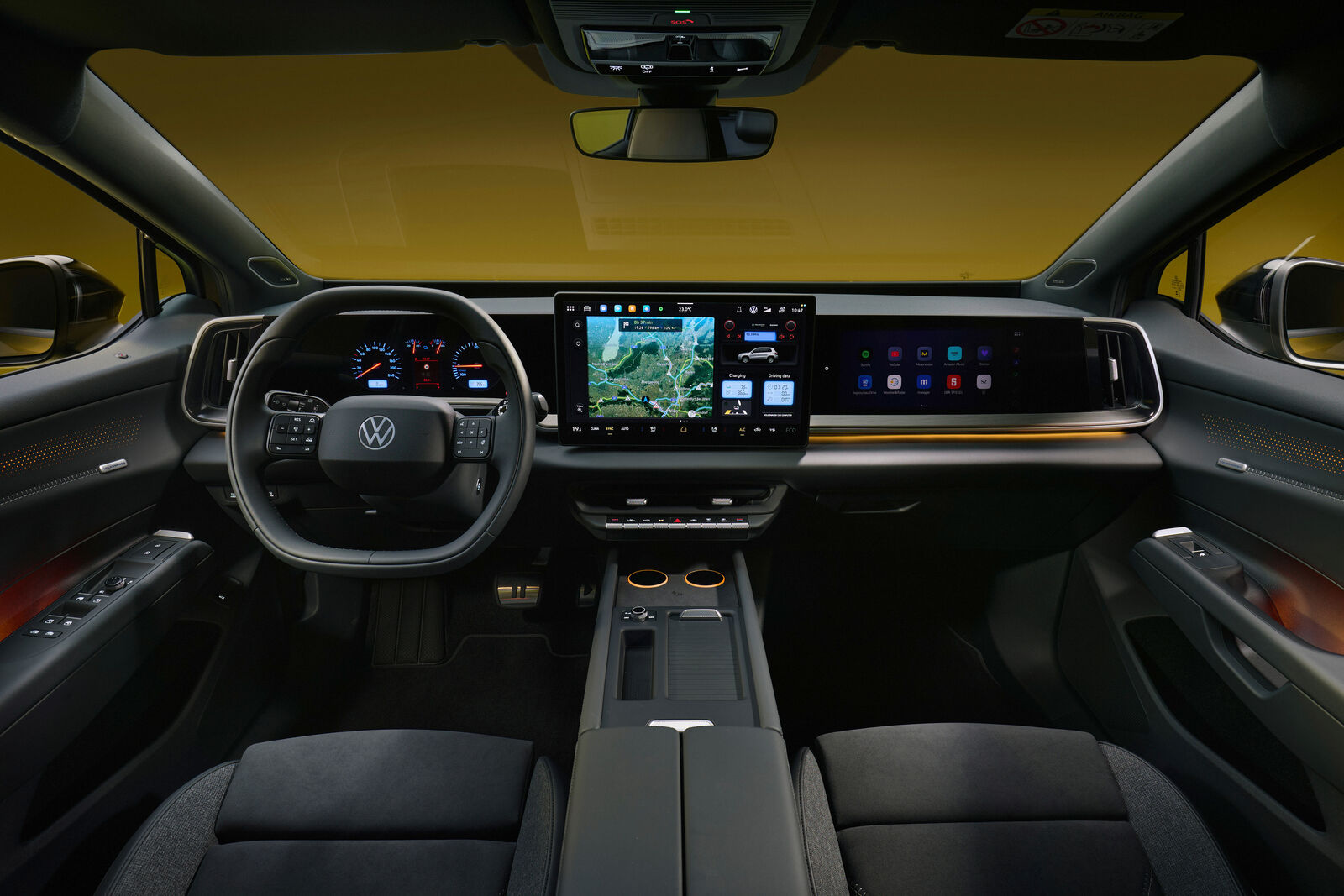
True Volkswagen as a promise. The interior of the new ID. Tiguan also follows the True Volkswagen philosophy and thus focuses on the core values of the brand. The new interior of the SUV is therefore characterised by consistently intuitive operation, a premium feel and an atmosphere that is welcoming in every respect. This feeling is reinforced by the clear interior architecture and elegant illumination of the decorative elements and trims.
Interior layout
Symmetrical structure. The basic layout of the interior in front of the driver and front passenger comprises a large display landscape, a centrally located control panel with physical buttons for the air conditioning functions and a large centre console. The latter has two stowage levels and a large stowage area in the middle, which is closed by a two-piece butterfly armrest. Placed in front: two inductive Qi2 charging bases for smartphones; a magnetic ring centres the smartphones in the charging base. The new chargers are also illuminated in the colour of the background lighting. Below the charging bases there is a second stowage level for items such as sunglasses.
Display landscape
Front passenger display for the first time. The ID. Tiguan generally impresses with innovative technologies in all areas. In the interior, this includes a multifunctional co-driver display available for the first time in a European Volkswagen, which allows the front passenger to immerse themselves in their own infotainment, information or gaming world without distracting the driver. This is because the display is not visible to the driver, like with a laptop privacy screen. Thefront passenger can listen to the sound on their paired Bluetooth headphones. The system’s range of functions will be continuously expanded in the future by over-the-air updates.
Displays from A-pillar to A-pillar. The technical centre of the interior is the new display landscape between the A-pillars. On a visual level, this informative, progressive and visually discreet unit is formed by the digital instruments (Digital Cockpit), the infotainment display and – in each case optionally – the augmented reality head-up display and the co-driver display. Here too, the clarity of the design is not only impressive from a visual point of view, but form also supports function in a much more specific way. The infotainment display (diagonal: 38.1 cm/15 inches) is positioned so that it is within easy reach of both the driver and front passenger. The front passenger display has a diagonal of 30.5 cm (12 inches). In combination with the new instruments (Digital Cockpit, 25.4 cm, 10 inches), this creates a display landscape that extends over almost the entire interior width and gives the interior its own unique character. In addition to the actual physical displays, the augmented reality head-up display virtually can project central functions into the space in front of the driver; this also includes interactive information such as turning arrows or the display showing the distance to the vehicle in front.
Retro meets high tech. The new ID. Tiguan will be equipped with the ‘Retro’ display for the Digital Cockpit as standard. The display is activated using the ‘View’ button on the multifunction steering wheel. In the ‘Retro’ display, the instruments change to the look of a Golf IV as a new feature. The corresponding ‘Retro’ view in the central infotainment screen can even be personalised. Here, the driver choose six different Volkswagen models, which are displayed then in a virtual garage: Golf I, Golf II Country, Golf IV, Tiguan I, Race Touareg and Beetle. In all cases, there is a classic speedometer on the left with an odometer and trip recorder. The display on the right is designed like a rev counter. However, it does not show engine speeds in the electric ID. Tiguan; instead, it shows the energy output or energy absorption of the drive system as a power display. To match this, the driver can also call up a ‘Retro’ display on the infotainment system in the look of the selected classic car by simply swiping. In this case, the vehicle functions arranged at the top and bottom of the screen are retained; only the look of the central home screen changes.
Controls
Digital and analogue controls in harmony. Whether retro or contemporary– Volkswagen has consistently implemented a clear operating logic in the ID. Tiguan. The systems of the predecessor have been completely replaced. The only exception to this is the automatic selector lever used in all new Volkswagen vehicles and the steering column switch for the wiper and turn signal functions. Everything else is new. Important functions can be accessed using physical buttons and are arranged in the interior where the respective function is intuitively expected. The air conditioning system is a prime example of this: the basic functions are controlled by means of a button bar in the centre console – click the temperature button upwards for warmer air; press the button downwards for cooler air. Simple and intuitive. Another example is the control for adjusting the audio volume and changing stations/tracks: here, an ergonomically positioned rotary pushbutton control in the centre console ensures intuitive operation. Placed in front of this are the two inductive charging bases for the driver’s and front passenger’s smartphones. The multifunction steering wheel is also new; clear physical buttons are used here instead of touch controls. A sporty detail in the ID. Tiguan R-Line: the 12 o'clock marking on the steering wheel rim.
Smart light
Light creates atmosphere. Light is an integral part of the information world and interior design in the ID. Tiguan. Depending on equipment, the decorative trims in the cockpit and door trims are backlit. In the Style equipment line, background lighting in 30 colours illuminates the dash panel, centre console and door trims as standard. In detail, the lighting in the doors is realised by means of a light curtain that falls into the interior through the perforated decorative elements. Depending on the lighting setting, the idea of the ‘golden hour’ is taken up here – a visual metaphor for a warm and positive lighting mood.
Light as a second information level. In parallel with the displays, the driver is supported by the ID. Light on board as standard in the Life, Style and R-Line specifications. This provides information while driving in the form of clear and intuitively perceptible light signals – for example, in the event of incoming calls or information from the assist systems. In conjunction with active navigation, the light strip supplements the display in the cockpit with clearly recognisable directional pulses and thus facilitates orientation. In addition, the ID. Light can warn of dangers – for example, if a vehicle is approaching from behind when the doors are opened.
Colours, fabrics and applications
Trend, Life and Style. Each equipment line of the ID. Tiguan creates its own atmosphere with its own unique character. While Trend with dark fabrics and a black roof liner focuses on a clean, reduced design, Life and Style bring extra warmth and homeliness to the interior. Particular attention is paid to the details: in the ID. Tiguan Style, fine topstitching on the seats and in the door inserts in Marcy design adds elegant accents; following the form, these seams transition into a Volkswagen badge. This cosy impression is rounded off by the background lighting, where precise perforations create a soft play of light, atmospherically illuminating the interior, particularly in the evening hours. The decor in the dash panel features a brushed aluminium look surrounded by a trim strip in the colour Float, thus seamlessly integrating it into this modern sense of space. In the Style specification, comfort seats in a material combination of ArtVelours Eco and Seaqual fabric ensure a high-quality impression. The light colour scheme Mistral makes the interior appear open and inviting, while the Soul colour scheme ensures an elegantly understated look. This creates an ambience that feels both high-quality and relaxed.
R-Line. In the Tiguan R-Line, the focus is on a sporty look. Premium sport seats with integrated head restraints and accents in ArtVelours Eco underline the dynamic appearance. Optional fully electric seats with massage function and seat climate control enhance comfort. In this case, the rear passengers also benefit from heated seats. Topstitching in Speedy design, exclusive R-Line logos and trims in Night Chrome give the interior of the ID. Tiguan R-Line a powerful, technical feel. The result is an interior that authentically combines sportiness, comfort and modern premium design.
Luggage Compartment
Plenty of space for passengers. Both the front and rear passengers on board the new ID. Tiguan have even more legroom compared with the Tiguan based on the MQB evo. Among other things, this additional space is due to the 84 mm longer wheelbase of the ID. Tiguan. With a luggage compartment capacity of 534 litres, the SUV also has enough space for the luggage of a family of five. If the ID. Tiguan is loaded up to the roof, a volume of 1,577 litres is available – stowage space on a par with an estate car. In addition, the ID. Tiguan has an additional frunk, which offers space for the charging cable, for example.
Recycling
A conscious material cycle. All contact surfaces in the ID. Tiguan are softly upholstered and finished to a high standard. Unlike in the smaller ID. models and the T-Roc, the upper part of the dash panel in the ID. Tiguan is not upholstered in a fabric, but – similar to the large Tayron – is finished in soft-laminated artificial leather. In the ID. Tiguan, this cover consists of a premium-quality TPO foam film with a high-quality look and feel. TPO stands for thermoplastic polyolefins –a material that can be fully recycled under suitable conditions. For many other interior features (including headliners, carpets, floor mats and selected seat covers), Volkswagen uses materials with recycled content. The Classic Melange fabric is made from Seaqual yarn, which is mainly produced from recycled polyester. A small proportion of marine plastic is additionally integrated into the yarn. In addition, Volkswagen dispenses with genuine chrome in the decorative and trim elements and uses chrome replacement paints.