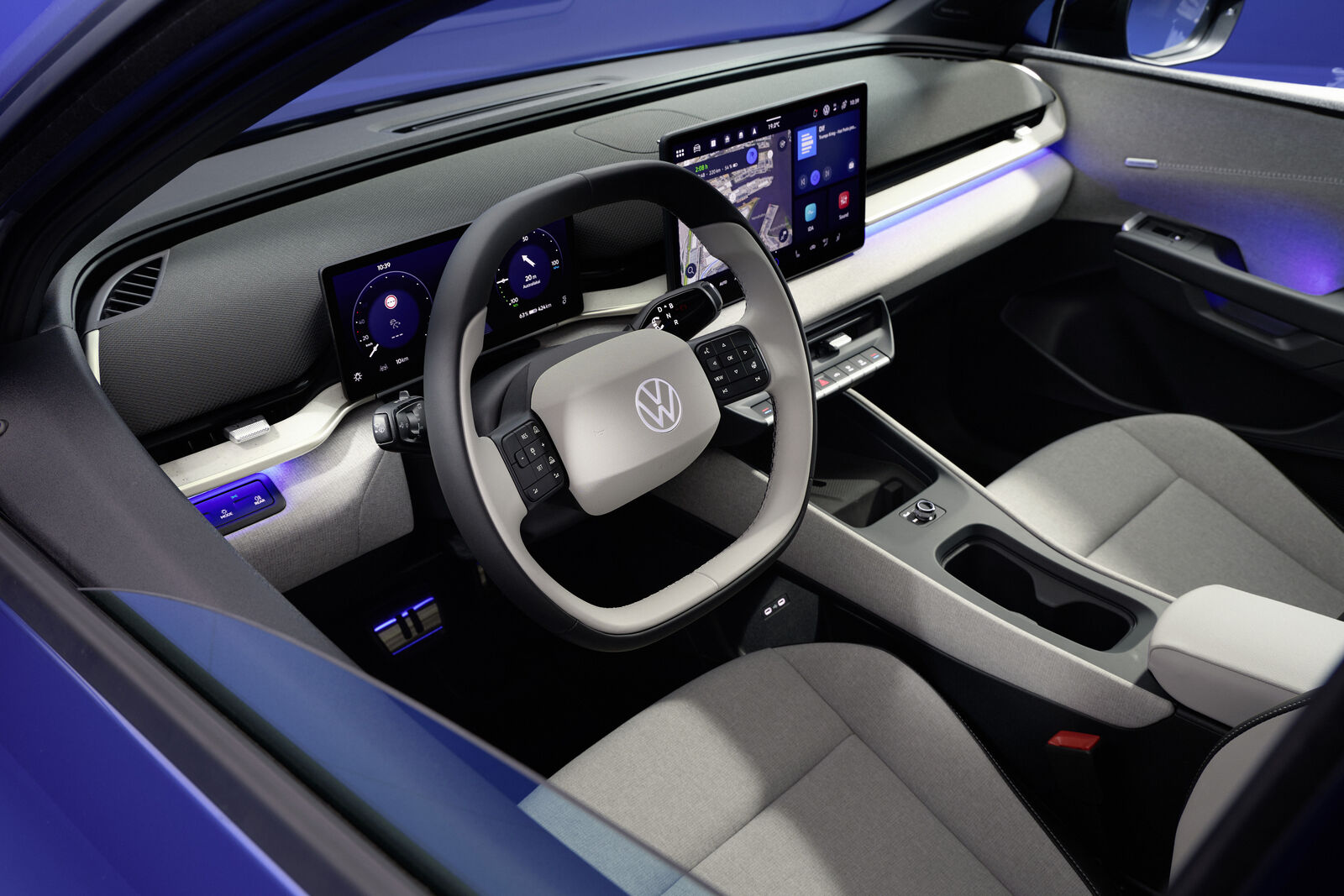
More space, more possibilities. Thanks to the particularly compact drive modules of the MEB+ platform, the new ID. Polo offers clear advantages in terms of space: as a result, passengers have 19 mm more interior space, which is particularly noticeable in the rear. The interior width and headroom have also increased. The luggage compartment volume has additionally grown by 25 per cent – from 351 to 441 litres. When the rear seat backrests are folded down, the load capacity increases to 1,243 litres (Polo MQB: 1,125 litres). This extra space makes the five-seater ID. Polo more of an all-rounder than any of its predecessors, specialising not only in urban life but also ideal for everyday use with friends and family well beyond the city limits. Every detail of the interior has also been completely revamped and redesigned. Among other things, the ergonomic blend of digital and physical controls as well as the horizontal architecture of the dash panel are decisive here. The digital instruments (Digital Cockpit) and the infotainment display integrated in the centre of the dash panel are ideally arranged on a visual axis for the driver. These two new displays alone showcase the outstanding quality, precision and functionality of the details on board the ID. Polo.
Digital Cockpit with “retro display”. The ID. Polo’s new cockpit landscape has a consistently horizontal structure. The Digital Cockpit and the infotainment display are arranged on one visual axis. The Digital Cockpit measures 26.0 cm (10 inches) across the diagonal and features brilliant graphics. If the driver uses the View button on the steering wheel to activate the retro display, the instruments transform into the style found in the later Golf I models. In this case, there is a classic speedometer on the left and a stylised rev counter on the right. However, in the all-electric ID. Polo this naturally does not display engine speeds, but rather the energy output or energy absorption of the drive as a power display. Like the power display, other modern functions such as Dynamic Road Sign Display have also been integrated into the layout from the early 1980s. The infotainment system’s touch display, which is located in the centre of the dashboard, measures 32.77 cm (13 inches) across the diameter and is as large as a premium tablet – and the quality of the graphics is just as precise. The display is also easy to reach for the front passenger.
Multifunction steering wheel with clear buttons. The multifunction steering wheel with its clearly arranged button panels has also been completely redesigned. The cruise control system or, depending on the equipment, Adaptive Cruise Control and Connected Travel Assist are combined in the button group to the left of the airbag and horn. This group also contains the volume control. To the right of the airbag is the group of buttons for controlling the Digital Cockpit, activating the voice control and the button for the steering wheel heating (heating function can also be activated later on demand). The steering wheel itself is flattened at the top and bottom (12 and 6 o'clock). The steering column switches for shifting gear and using the parking brake (right) and the turn signal, lighting and wiper functions (left) are located behind the steering wheel in an easily visible and accessible position. The central functions for the headlights and tail light clusters are also located to the left of the dashboard.
Digital and analogue in harmony. The central climate control functions – temperature control, blower, air conditioning on/off, automatic climate control mode, air recirculation, windscreen defroster, rear window heater – are integrated separately into a strip with easy-grip buttons in the centre console, while the hazard warning light switch is located in the centre. On the level below, there is the smartphone storage area with an equipment-dependent inductive charging option, two drink holders and the centre armrest with an integrated stowage compartment underneath. Between the smartphone storage area and drink holders, there is the rotary control for audio functions, which is equally easy to reach for the driver and front passenger. This can be used to adjust the volume and also to change songs and stations using the track function. The ID.Light (standard equipment from Style and above) has undergone a major upgrade: for the first time, the interactive and intuitive light strip visible to the driver extends into the bottom of the windscreen, not just across the width of the dash panel, but now also into the front doors. Another new feature: the door openers designed for optimum ergonomic grip. The four buttons for the electric windows and exterior mirror adjustment are also designed as a control panel in the driver’s door. However, attention to detail is not only reflected in the intuitive design of all elements and the quality of the materials, but also by equipment-dependent intricate details such as the elegant decorative seams in the door trim and the integration of small Volkswagen badges at the ends of these premium seams.
Sustainable materials. The materials used in the ID. Polo are not only high in quality and part of an innovative and friendly design but are sustainable wherever possible. For example, all textile fabrics in the seats and doors as well as the upper side of the headliner and carpets are made completely of rPET materials – recycled polyethylene terephthalate, a thermoplastic that is mostly obtained from PET bottles. The top-of-the-range seats in the ID. Polo also use a fabric made from SEAQUAL® yarn – its base material is ocean plastic that is collected and then recycled. The horizontal trim (“Milkyway” design in the top-of-the-line version) below the air vent openings is also made from a new recycled material. All these details combine the aspect of sustainability with an emotive warmth.