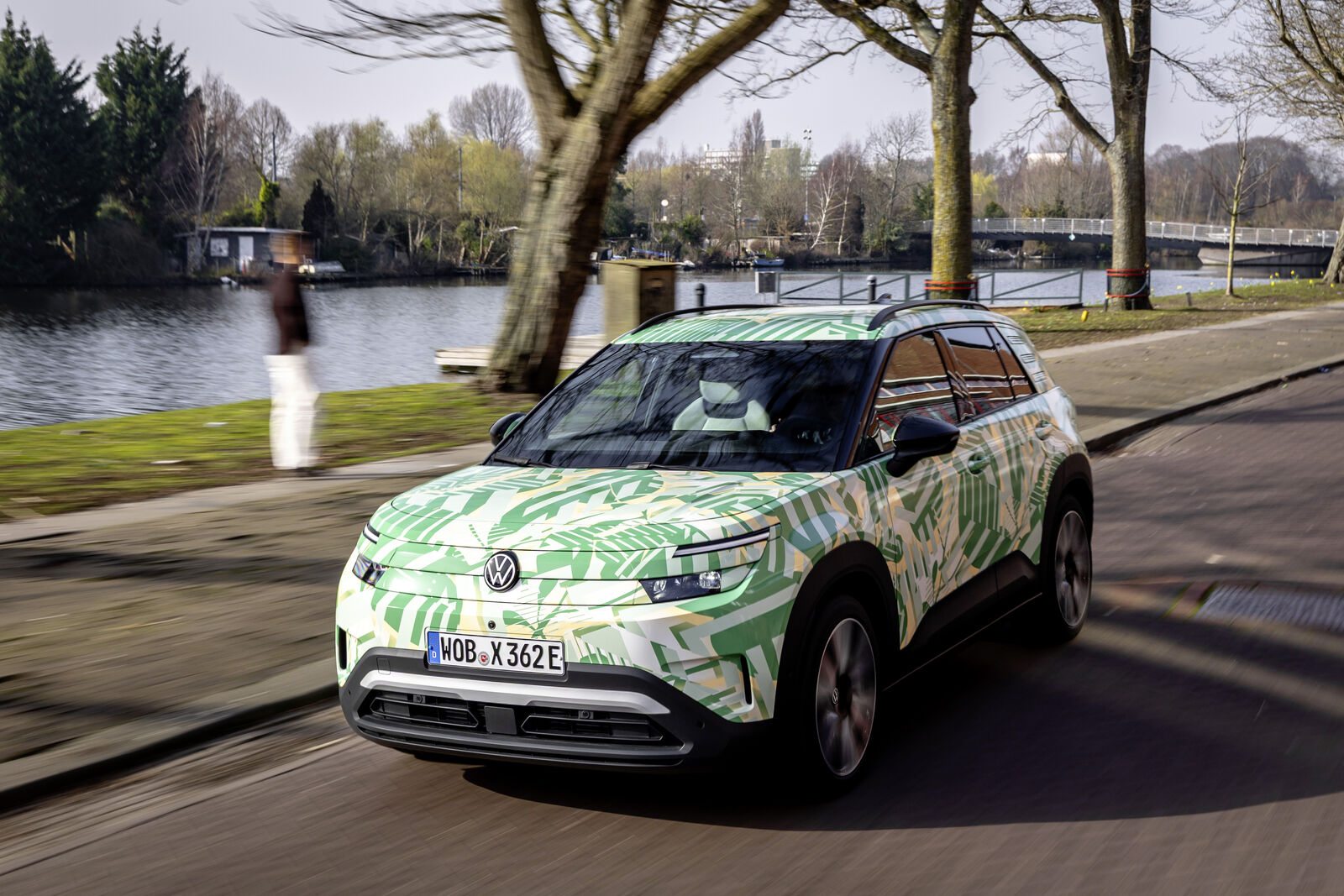
MEB+ with front‑wheel drive. The ID. Cross utilizes the latest evolutionary stage of the Modular Electric Drive Toolkit: MEB+. For the first time since the e‑up! and e‑Golf, Volkswagen is again combining the electric drive with front‑wheel drive only. The larger ID. models, by contrast, use rear‑ or all‑wheel drive. The dynamic heart of the ID. Cross system is the new APP290 electric motor. APP stands for Axial Parallel Position – the parallel orientation to the axle; 290 reflects the maximum torque in newton‑meters. The new electric motor will be available in three output levels at launch: 85 kW (116 PS), 99 kW (135 PS) and 155 kW (211 PS).
New pulse inverter. Flanged onto the motor housing is a 1‑speed gearbox including housing and the newly developed pulse inverter. It coordinates power and torque delivery as well as recuperation. In addition, this power electronics unit converts the battery’s direct current (DC) into alternating current (AC) required by the electric motor. The new pulse inverter is a dedicated Volkswagen development which, thanks to high‑tech components and high‑quality materials, increases efficiency and thus reduces the SUV’s energy consumption. Because the component is developed and produced internally, cost advantages are created that have a direct impact on the attractive entry price of the ID. Cross. Other components integrated compactly into the front section include the AC and DC charging ports on the front right, the nearby onboard charger and the electric A/C compressor. The compressor has been extensively decoupled from the body and therefore does not transfer vibrations into the cabin.
“Unified cell”. Between the front and rear axles, integrated into the vehicle floor, lies the flat lithium‑ion battery system of the ID. Cross: the Unified Cell. As the name suggests, it is a completely new development by the Volkswagen Group and its subsidiary PowerCo. The new battery system uses cell‑to‑pack technology, in which cells are assembled directly into a battery pack without the intermediate step of module housings. Three of these packs form the energy storage unit within the battery system. Its housing simultaneously reinforces the vehicle body structure. The battery will be offered in the ID. Cross with a net energy content of 37 kWh as a lithium iron phosphate variant (LFP) and 52 kWh as a nickel‑manganese‑cobalt version (NMC) with even higher energy density. AC charging power at home wallboxes and public charging stations is 11 kW. The smaller battery can be charged at DC fast‑charging stations with up to 90 kW, the larger one with up to 105 kW. Forecasts for charging from 10 to 80 percent with 90 kW assume a duration of around 27 minutes; at 105 kW and a particularly flat charging curve this time is reduced to around 24 minutes.
Sound design. The exterior sound of the ID. Cross has also been redeveloped. The reason: at low speeds of up to 20 km/h, a sound audible to pedestrians is required for nearly silent electric vehicles in many EU markets. Volkswagen has now designed a new brand sound. Various parameters were incorporated to make the acoustic experience as pleasant and fascinating as possible. The new sound is active up to 25 km/h in all driving modes and profiles. In the “Sport” profile, a particularly charismatic sports sound is additionally generated up to a speed of 50 km/h. The soundscape is adjusted in real time depending on driving‑relevant variables such as speed, accelerator position and drive torque.