MEB+ with front-wheel drive as the starting point. At the start of the development of the Mission Efficiency, a technical 3D package was created with the ID. Polo front end and all new parameters to be defined. The entire team also agreed that the Mission Efficiency should be recognisable as a Volkswagen and suitable for everyday use despite its ambitions to beat records. This gave rise to the concept of a 2+2-seater with a highly usable luggage compartment. The drive system was also just as important as the aerodynamics, design and space efficiency. However, since it and its battery were taken from the ID. Polo, the drive did not have to be redesigned. Nevertheless, modifications were also incorporated here as part of the development process.
Development is teamwork. The stated goal of all parties involved: “We will build the most efficient vehicle in its class.” The Preliminary Development department took the lead here. Various pre-development topics were brought together in the creation process of the Mission Efficiency. The dominant development area in this project was aerodynamics, because drag is the most important variable for efficiency in addition to the drive system and weight. As the drive adopted from the new ID. Polo (MEB+) already offered maximum efficiency, it was possible to focus on bringing the drag to a new record level and saving weight by reasonable means. Against this background, other areas such as design were subordinated to aerodynamics. Thanks to close and continuous integration of all development areas, this was so successful that the subsequent final design draft corresponded perfectly to the actual aerodynamics specifications apart from a few minor details. The design makes the concept car’s efficiency visible in a particularly attractive way – with the parameters of the new Volkswagen Pure Positive design language.
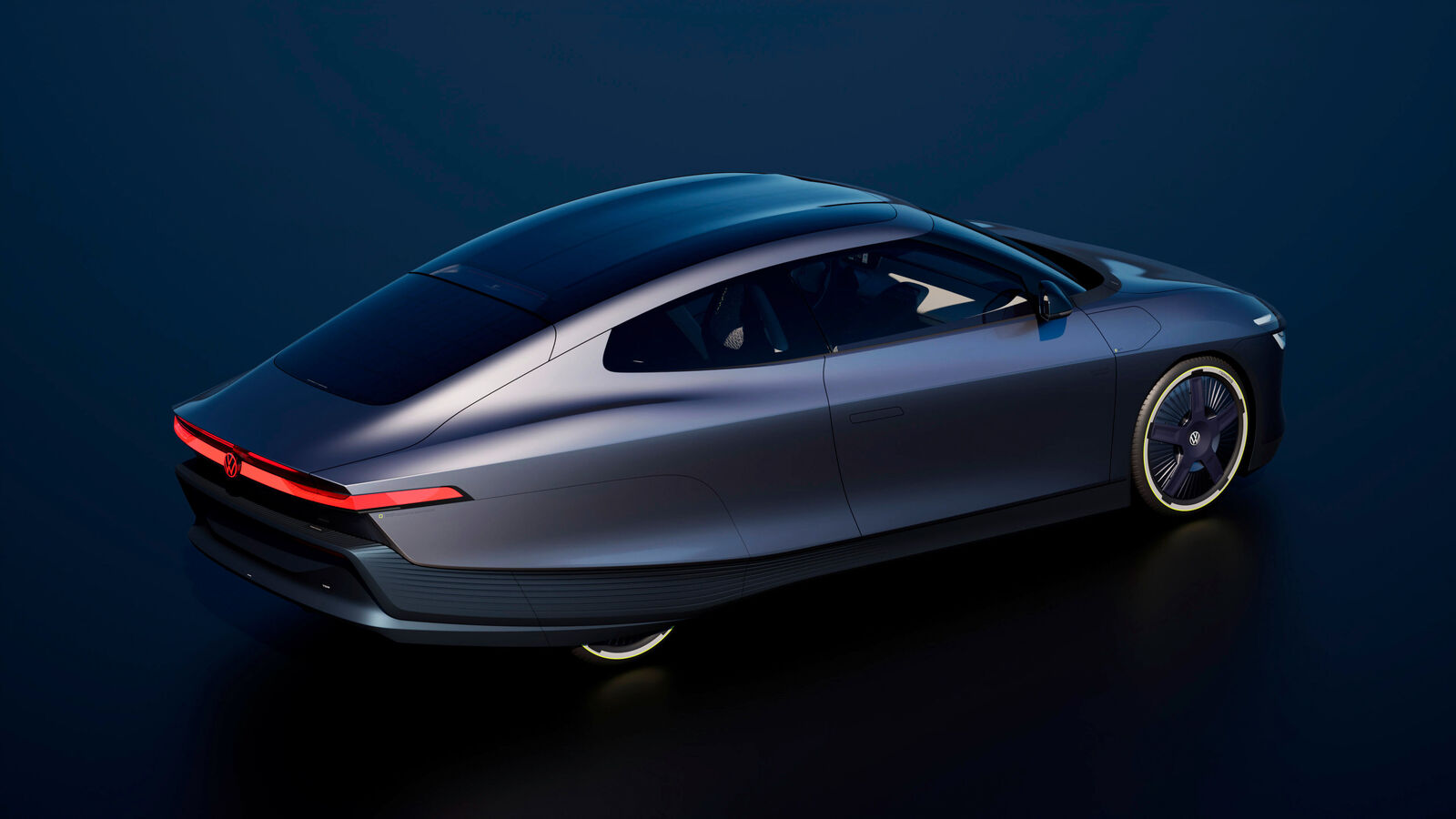
Longtail like the XL1 and the record-breaking vehicle ID.R. The pioneeringly low drag as a product of the drag coefficient (Cd = 0.158) and small frontal area (A = 2.08 m2) is largely due to the extremely long and flow-optimised teardrop shape of the body. Here, the aerodynamics and the design were based on the results of computer simulations and wind tunnel tests as well as experience with extreme vehicles such as the XL1 built in a special series and the record-breaking ID.R. It was clear from the outset that an elongated coupé shape with a tapered rear end would offer the greatest efficiency potential. In the Mission Efficiency, this tapering occurs in both width and height to keep the air flowing close to the vehicle body for as long as possible, thereby preventing flow separation and the resulting drag-inducing turbulence, known as the wake. As an interesting side note, the basic shape of the body alone accounts for 47 per cent of the first-class aerodynamic properties of the Mission Efficiency. However, the Volkswagen vehicle is not only impressive in terms of facts and figures, but also thanks to its striking design aesthetics. Characteristic features here are a sports car adaptation of the current front end from the latest ID. models, the almost 4.80-metre-long and very flat coupé or fastback silhouette with the fully enclosed rear wheels and the narrow rear end. The aerodynamics and design of the Mission Efficiency in detail:
FRONT END
Member of the ID. family with front-wheel drive. The front end is largely based on the production components of the ID. Polo and thus on the MEB+ with front-wheel drive. In order to allow the bonnet to slope down particularly low and thereby reduce the frontal area and drag, it was moved downwards in the area of the cowl panel and windscreen base and its hinges were moved forward. The bonnet is thus raised towards the headlights when opened. The wiper housing concealed in front of the windscreen on the ID. Polo was exposed by this measure; rising towards the windscreen, its design makes the aerodynamic air routing clearly visible. Both functionally and visually, the area is inspired by the structure of aircraft wings. Like the A-pillars, the flat aerodynamic windscreen was also optimised for better airflow. Technically, the LED headlights of the ID. Polo follow below the bonnet. A key component of the aerodynamic concept is also the new ‘Clean Aero Front’ below the illuminated horizontal bar, which incorporates the VW badge. The smooth-surfaced area extends downwards towards the road into an area with active cooling air flaps and transitions outwards into air guide elements. These air guide elements channel the air in a targeted manner towards the striking, lateral air guides of the lower silhouette.
Front end with active cooling air flaps. Three active cooling air flaps integrated flush into the front end – one large central flap and two smaller ones on the outside – are a special technical feature. They can be opened and closed in several stages, individually or in combination, and offer five opening cross-sections. Whenever possible, the flaps only provide the minimum opening area required in order to keep the air resistance as low as possible. During DC charging of the Mission Efficiency, the flaps are also opened in order to optimise the thermal conditions. The flaps first move backwards and then swing out of the airflow. The flaps are opened and closed in stages. If all three flaps are closed, no air can enter – the Mission Efficiency then achieves a Cd value of 0.158. The fact that, unlike a petrol or diesel engine, the electric drive motor does not require combustion air or similarly strong cooling naturally has additional advantages. The otherwise usual air curtains for airflow around the front wheels could be dispensed with due to the optimally designed front aerodynamics with side air guides and active cooling air flaps.
SILHOUETTE
Patented rim deflectors. The smooth-surfaced silhouette is characterised by its long length of almost 4.80 metres at a height of less than 1.40 metres and an extremely long character line that extends from the front to the rear. No less distinctive are the striking integration of the wheels and the rising side member tapered towards the rear – from an aerodynamic point of view, this is an integrated air guide element. Here, too, form consistently follows function. The type of wheel and tyre integration is also particularly interesting. This is because the wheels are responsible for 25 to 30 per cent of the aerodynamic resistance. Consequently, a high amount of effort was required to develop new solutions. In the case of the front wheels, for example, the wheel arch was placed close around the radius of the tyre to reduce turbulence in the wheel housing. In addition, new and patented rim deflectors are used on the inside of all wheels. They prevent air from entering the rims and causing turbulence there. On the visible outside of the wheels, the flat, flow-optimised design of the hubcaps contributes to the excellent aerodynamics. As the hubcaps are made of a transparent material, the rims still have a three-dimensional look. However, this look is only recognisable at the front, as the rear wheels are fully enclosed.
Controlled airflow. The full cladding of the rear wheels makes a significant contribution to ensuring that the airflow to the rear remains continuous and is guided to the rear end in a controlled manner. The air guide in contrasting colour and sweeping up towards the rear is also integrated into this optimum airflow behaviour. Towards the rear, it merges into the aero diffuser. The design of this rear side area is unique and makes the surface of the side section appear to be as streamlined as it actually is, despite the fully enclosed wheels. The panelling itself is cleverly used for additional stowage space in the sides of the body: on the front passenger side, for example, there is a stowage compartment for the charging cable behind the fold-down trim. Tyres from Continental developed specifically for the concept car make a significant contribution to record efficiency. They are based on the standard EcoContact 7 tyre and combine a tread developed for extremely low rolling resistance with aerodynamically optimised sidewalls. This reduces energy losses and significantly supports the exceptional efficiency of the vehicle.
Well-judged decisions. When it came to the exterior mirrors, a deliberate decision was taken not to use camera systems. Well-designed conventional mirrors have only a limited aerodynamic disadvantage, while camera modules would have required additional energy for the cameras and displays and might not have provided the required field of view due to the vehicle’s side curvature. Nevertheless, the mirror glass and housing were specially developed and optimised up to the legal field of view limits. In the area of the door handles, on the other hand, the team did not choose a conventional solution as the smooth-surface recessed door handles could be adopted from the Group modular matrix. They extend electrically, but still operate the lock itself mechanically; they can therefore also be opened in the event of a power failure.
REAR END
Elongated coupé shape. With its charismatic design, the narrow rear of the Mission Efficiency immediately makes it clear that no ordinary car is on the road here. ‘Form follows function’ becomes a tool and a style element. Viewed from above, the roof surface – with its central recess – flows seamlessly into the rear section, merges into the boot lid and then finds its aerodynamically precise conclusion at the spoiler lip above the tail light clusters. The lines of the side section also taper here and flow into the spoiler lip. Braking air turbulence is thus prevented better than ever before. In design jargon, this elongated and aerodynamically optimised coupé shape is called ‘boat-tail design’ – referring to the lines of a boat’s stern. In the case of the Mission Efficiency, the rear end transitions into the razor-sharp-looking spoiler lip. This precisely designed lip controls the airflow and separates it from the rear of the vehicle with minimal turbulence. At the same time, the spoiler lip, barely recognisable as a spoiler, reduces lift at the rear axle, thereby increasing the driving stability of the Mission Efficiency.
Horizontal LED bar and aero diffuser. The upper and lower rear areas are divided by a wide, red LED rear light bar with the VW badge, which is also illuminated in red. The narrow horizontal LED bar extends into the side areas and lends the rear end more width and its own distinctive elegance. Around half of the purely vertical rear area is occupied by the aero diffuser, into which the side air guides merge. Here, the airflows from the underbody and sides are guided away in a targeted and precise manner.
UNDERBODY
Continuous underbody cladding. Another decisive aerodynamic factor of the Mission Efficiency is the underbody, which is almost completely enclosed by a cladding. In order to achieve the necessary progress for a Cd value of 0.158, Volkswagen uses aerodynamically shaped axle claddings and special air guide elements as shields in front of the front and rear wheels. Significant progress was also achieved through the patented rim deflectors. These air guide elements greatly reduce braking air turbulence in the wheels. In addition, the rear axle of the ID. Polo was heavily modified for use in the Mission Efficiency – it was made narrower and the spring control arm was removed from the airflow. Putting this into context, approximately 12 per cent of a vehicle’s aerodynamic drag occurs in the underbody area – the optimisations here therefore have a noticeably positive effect in the case of the Mission Efficiency.
COLOUR
Aero Silver Grey and Stardust Blue. The paintwork of the body in Aero Silver Grey specifically matches the aerodynamic design. It acts like liquid metal and harmonises perfectly with the sculptural lines of the Mission Efficiency. The colour of the aerodynamic add-on parts matches the Aero Silver Grey paintwork. They feature a new petrol shade with the designation Stardust Blue. This comes in two versions: while the air guides and the wiper box surround have a matt finish, for example, details such as the A-pillars and mirror covers are painted in high-gloss Stardust Blue. Stellar Glow is used as a luminous contrast. This colour enhances the details of the rims, symbols, lettering, seat belts and trim surfaces in the interior.