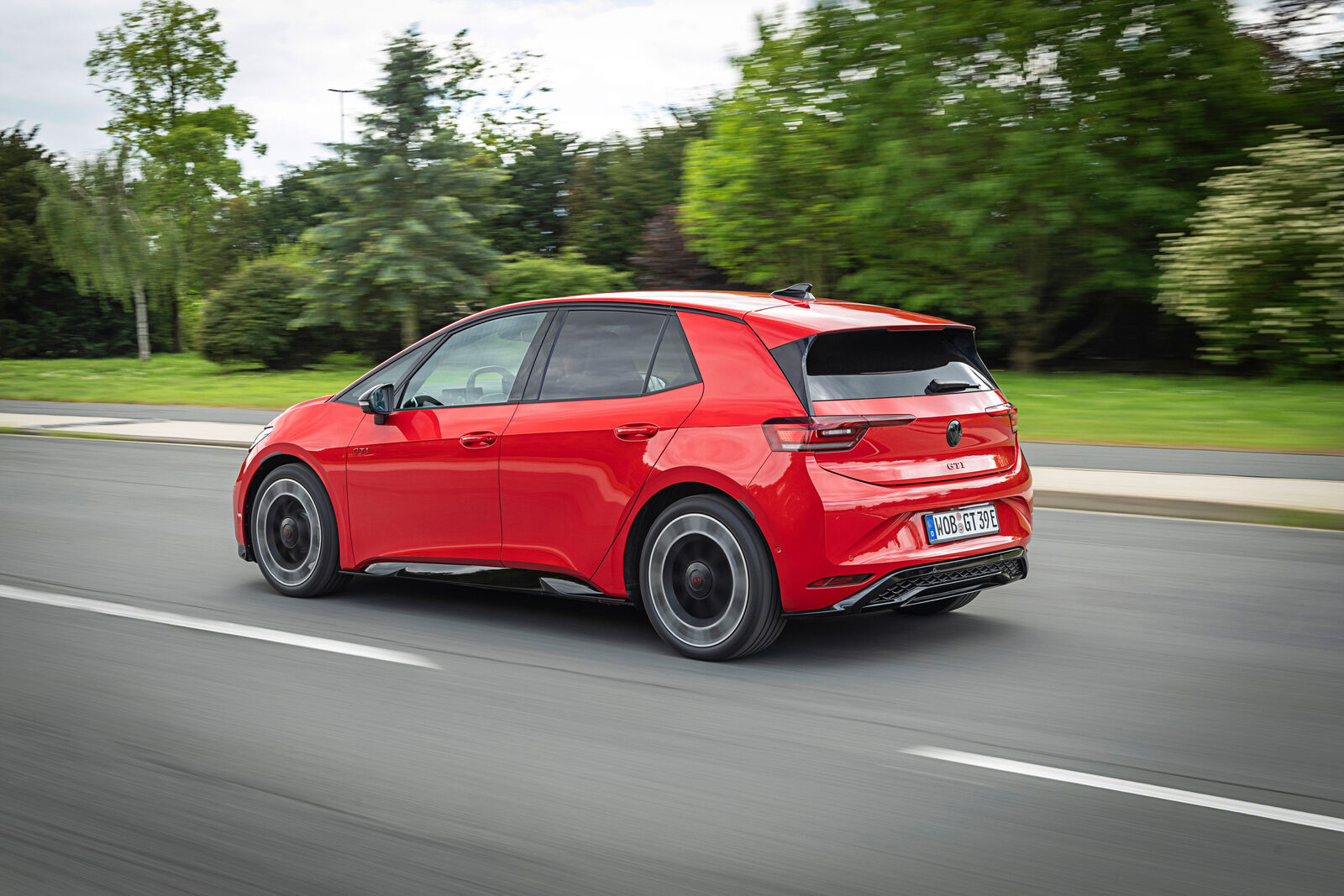
GTI character. The drive system, which has been further optimised compared with the ID.3 GTX, develops an output of 240 kW (326 PS) and a maximum torque of 545 Nm. The drive power is transmitted to the rear axle via a one-speed gearbox, making the ID.3 GTI the first Volkswagen in the history of the GTI with rear-wheel drive. The resultant particularly superior road adhesion in this performance class is provided by 20-inch wheels and size 225 tyres (optionally 235) as standard. GTI mode with active Launch Control helps the driver to accelerate the ID.3 GTI to 100 km/h in just 5.6 seconds if required. The top speed is electronically limited to 200 km/h. The further developed fine tuning of the chassis also ensures that the new ID.3 GTI achieves longitudinal acceleration and acceleration out of bends with a level of confidence matched by virtually no other electric vehicle in its class.
GTI drive system in detail. The drive system of the ID.3 GTI is named ’APP550’. APP is the abbreviation for Axial Parallel Position, describing the axial parallel configuration of the permanently excited synchronous motor; the number 550 reflects the maximum torque in newton-metres. The system essentially consists of the electric drive motor, the two-stage one-speed gearbox, and the pulse inverter (power and control electronics). The electric drive motor is supplied with power by a lithium-ion battery with a net energy content of 79 kWh. Based on the forecast value, Volkswagen currently expects that the ID.3 GTI will achieve WLTP ranges of up to 601 km. The battery can be charged from 10 to 80 per cent in around 29 minutes using the DC quick charging function with up to 183 kW; this is also a forecast value.
GTI chassis and GTI steering in detail. The electronically controlled chassis of the ID.3 GTI has been tuned to the very high performance of the APP550 drive system. The basic layout consists of a MacPherson front axle and a five-link rear axle with a sophisticated guidance system. As with all GTI models, a progressive steering system is used as standard. Thanks to its progressive ratio, it offers additional steering precision and steering agility; at low speeds, it makes manoeuvring easier. In addition, the ID.3 GTI is equipped with the adaptive chassis control DCC as standard. The DCC system can be driven in various settings using the pre-configured driving profiles. In the Individual profile, the driver also has the option of setting the DCC chassis individually in a wide range from comfortable to very sporty. In the new GTI mode, the chassis automatically switches to a setting for maximum sportiness. Among other things, the elastokinematics of the front axle have been specifically adapted to make steering even more agile. The GTI tuning is perfected by modified springs, shock absorbers, anti-roll bars and tyres specially designed for the ID.3 GTI. New parameters for the adaptive chassis control DCC and the vehicle dynamics manager also perfect the handling. Overall, the new ID.3 GTI offers fascinating longitudinal dynamics, while at the same time offering high agility, particularly superior acceleration out of bends and exceptional long-distance comfort as an all-round vehicle.
New electronic engine sound. The exterior sound of the ID.3 GTI has also been developed from scratch. The background: at low speeds, in many countries it is a requirement that pedestrians must be able to hear an inherently silent electric vehicle. This is why Volkswagen has designed a new brand sound. Various parameters are incorporated here to make the sound experience as pleasant and exhilarating as possible. The new sound is active up to 25 km/h in all gear selector positions and driving profiles. In the Sport mode driving profile, a particularly charismatic sports sound is also generated up to speeds of 50 km/h. The sound tapestry is adapted in real time depending on driving-relevant variables such as speed, accelerator position and drive torque.