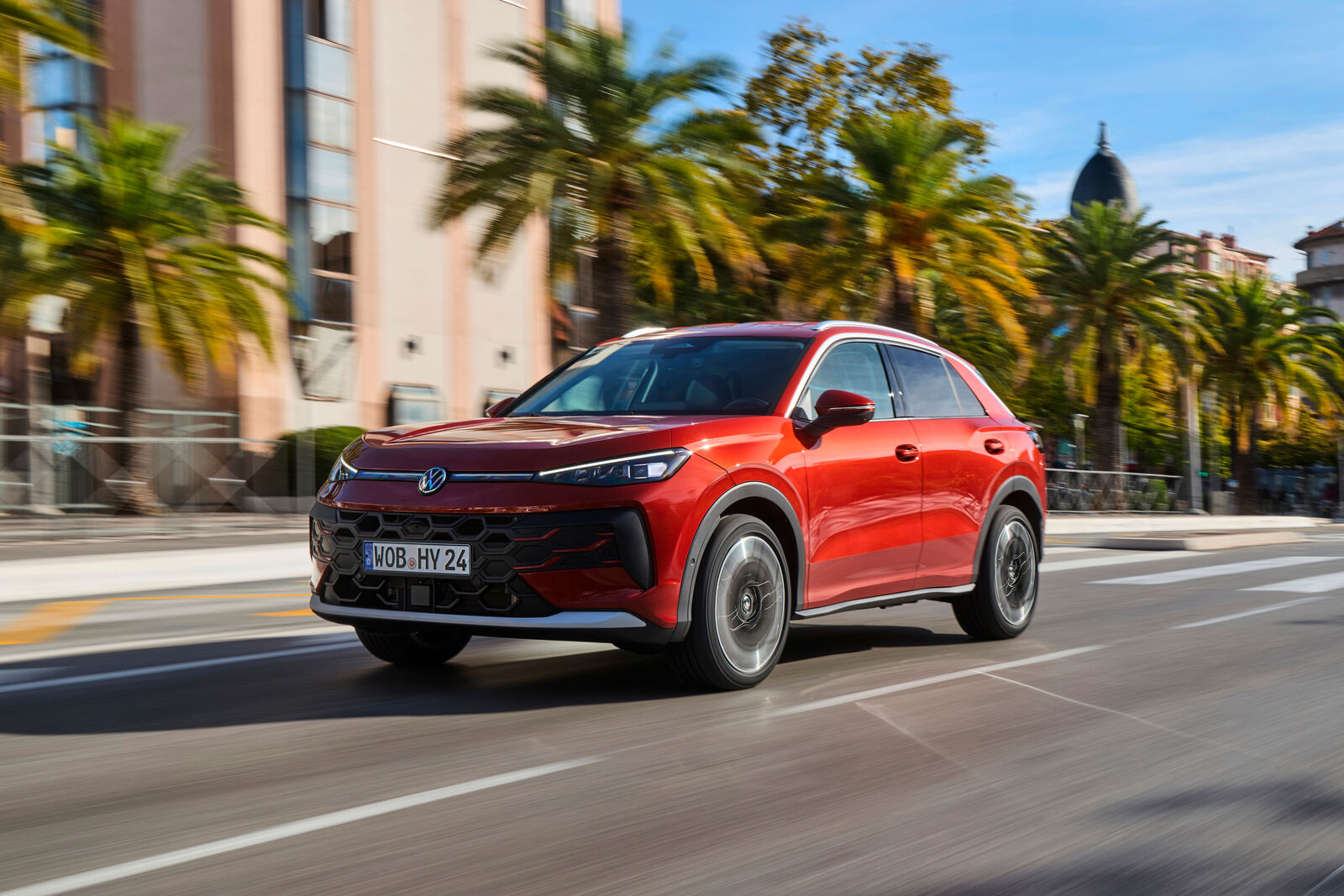
Two electric motors, one petrol engine. The new hybrid system essentially consists of the high-voltage battery under the rear bench seat, a 1.5-litre four-cylinder turbocharged petrol engine (1.5 TSI evo2) and the hybrid module integrated next to it on the front axle. The latter combines the generator motor, drive motor and a one-speed gearbox (type TQ250-1F) in a modular housing unit. The generator motor also acts as the starter for the TSI engine, while the drive motor is additionally responsible for recuperation. The power electronics – the control centre of the drive – are located on the main housing of the hybrid module.
Other vehicle components include a high-voltage to 12-volt converter, an electromechanical brake servo and an electric A/C compressor. The latter ensures that the air conditioning functions work even when the TSI is deactivated.
TSI connected to the drivetrain. The TSI is mechanically connected to the drivetrain or hybrid module by a hydraulically actuated clutch. When the clutch is closed, the turbocharged petrol engine transfers its power directly to the front wheels; the electric drive motor supports the TSI when required. This parallel drive is also automatically activated as soon as the Golf or T-Roc exceeds a speed of approx. 60 km/h or if the driver requests a very dynamic power response – for example, by using the kickdown function.
TSI separated from the drivetrain. When the clutch is open, there are two drive modes. If the lithium-ion battery located under the rear bench seat is sufficiently charged, the electric drive motor drives the car on its own up to around 60 km/h. However, if the energy content of the battery is no longer sufficient, the system operates in series: in this case, the combustion engine drives the generator motor, which in turn generates the energy for the drive motor.
Efficient operating strategy. The operating strategy determines which operating mode is activated. Among other things, this control system developed by Volkswagen takes into account the vehicle speed, requested wheel torque, battery charge level, temperature, emission requirements and operating profile of the auxiliary consumers. The aim is to provide the most favourable combination of efficiency, comfort and performance in every situation. The change between the operating modes takes place automatically and is virtually imperceptible. In series operation, the operating strategy ensures that the turbocharged petrol engine operates along an efficiency-optimised curve: The recharging power is only increased to the extent that this improves the overall efficiency. Above the optimal threshold, the system refrains from additional charging. In a later phase, the Volkswagen can use this energy again for all-electric driving. This means that efficient hybrid phases and electric driving shares alternate as required. The efficiency of the overall system is crucial here. The software therefore not only evaluates the consumption of the petrol engine, but also the energy balance of the generator and drive motors, power electronics, battery and mechanical drivetrain.
TSI with 96 kW and 110 kW. The 1.5 TSI evo2 is used as the combustion engine. It is available with two output levels, 96 kW (131 PS at 3,700 rpm) and 110 kW (150 PS at 4,300 rpm). The maximum torque of the 96 kW version is 250 Nm and is available between 1,750 and 3,600 rpm. In this case, the system power and system torque of the overall hybrid drive system are 100 kW (136 PS) and 288 Nm respectively. The 110 kW (150 PS) engine develops its maximum torque of 250 Nm between 1,750 and 4,000 rpm; the system power here is 125 kW (170 PS) and the system torque 310 Nm.
TSI with high efficiency. The four-cylinder direct injection engine is characterised in both output stages by the TSI-evo combustion process and variable turbine geometry (VTG turbocharger). In the TSI evo combustion process, the decisive factor regarding efficiency and power output is the symbiosis of the Miller cycle (early intake valve closing with a high compression ratio of 12.5:1) and VTG turbocharging. Thanks to this combustion process in which the fuel is burned very cleanly, the 1.5 TSI evo2 operates with very high efficiency. This minimises consumption and emissions. Other technical parameters of the TSI include a newly designed inlet camshaft. What’s more, as the new hybrid drive covers low load and rpm ranges primarily using electric power, Volkswagen was able to systematically design the turbocharged petrol engine for its particularly efficient operating points. A special speed controller sets the desired operating points of the TSI quickly and reproducibly.
1.6 kWh high-voltage battery. The also newly developed high-voltage battery uses 84 prismatic nickel-manganese-cobalt (NMC) cells and has a gross capacity of 1.6 kWh. The cell chemistry is adapted to the particularly frequent charging and discharging processes in full hybrid operation. A central battery management system monitors the cell voltages, temperature, charge level and power release. The battery is liquid-cooled and designed for a very wide temperature range. Its high power density supports dynamic boosting and rapid energy absorption through recuperation. A special operating strategy ensures that the compact battery is kept in an optimal working range at all times. For this purpose, the control system takes into account both the power reserve for acceleration and the storage capacity for recovered braking energy. As speed increases, the recuperation potential typically grows, while at very high speeds, for example, less additional boost energy needs to be held in reserve. The permissible charge level range is therefore continuously adapted to the driving situation.
Three driving profiles. The driver can choose between three driving profiles on board the new Golf Hybrid and T-Roc Hybrid: Eco, Comfort and Sport. In the Eco driving profile, the maximum system output is limited to 70 per cent, and the boost function is deactivated to reduce energy consumption. The Comfort profile does not limit the system output and allows boosting. In the Sport driving profile, the sporty characteristics are achieved by the drive changing earlier to series mode so that full power is made available quickly. The new hybrid drive thus covers a wide spectrum: from quiet electric driving to efficient long-distance driving and dynamic overtaking manoeuvres.