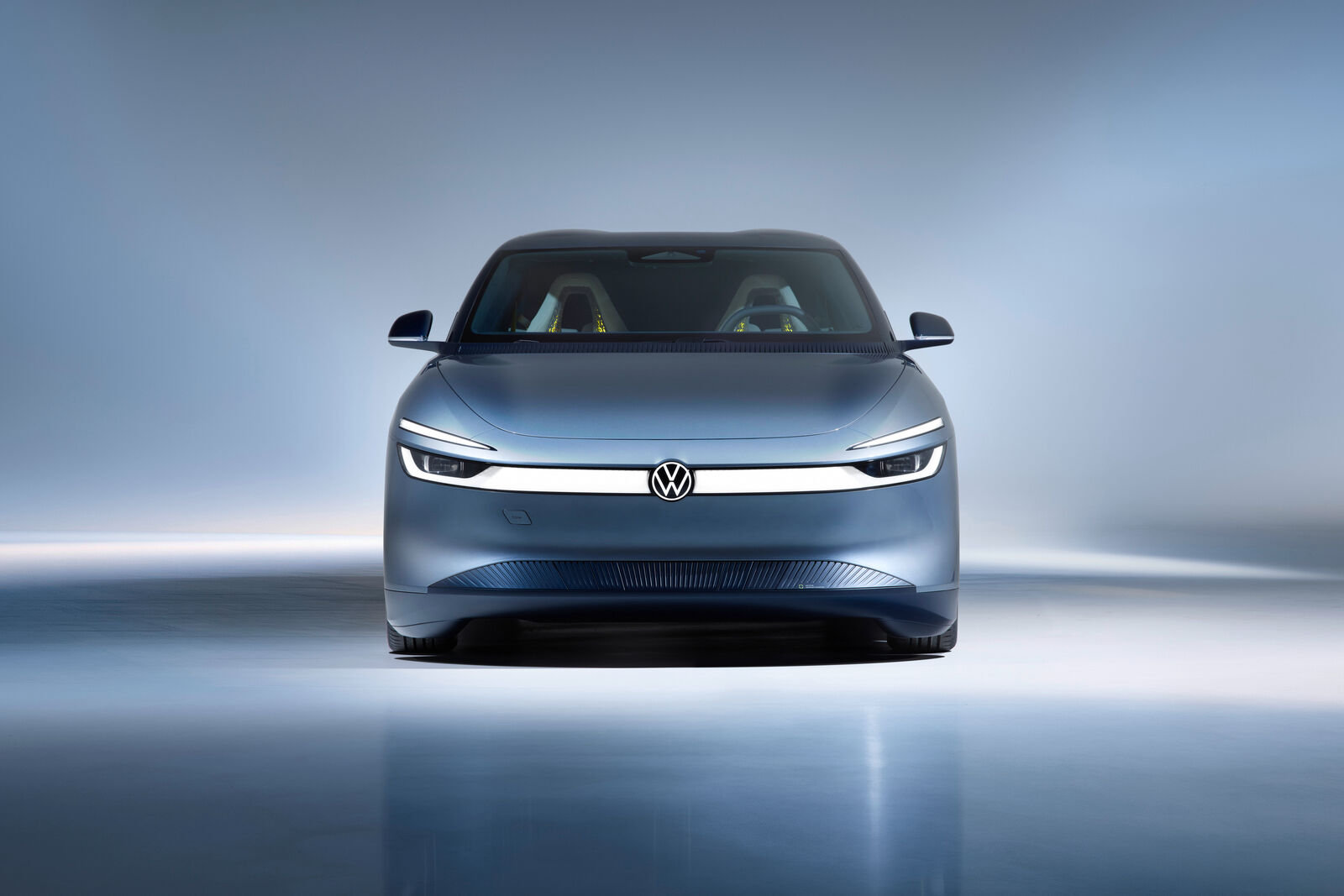
What is the Volkswagen Mission Efficiency?
The Mission Efficiency is a near-production electric concept vehicle developed by Volkswagen to demonstrate the efficiency potential of the MEB+ platform and its front-wheel-drive electric drivetrain.
What is the drag coefficient of the Mission Efficiency?
The Mission Efficiency has a drag coefficient of Cd 0.158.
How much energy does the Mission Efficiency consume?
During the officially documented record drive from Wolfsburg to Vienna, the vehicle consumed 6.89 kWh/100 km excluding charging losses and 7.51 kWh/100 km including charging losses.
How far was the record drive?
The officially documented route covered 1,278.36 kilometres from Wolfsburg via Poznań and Olomouc to Vienna.
How many times was the battery charged during the record drive?
The 54.9-kWh battery was charged once during the 1,278.36-kilometre journey.
What battery does the Mission Efficiency use?
The vehicle uses a 54.9-kWh net lithium-ion NMC battery based on cell-to-pack technology.
What electric motor does the Mission Efficiency use?
The vehicle uses the APP290 permanently excited synchronous motor in its 99-kW (135-PS) version.
Does the Mission Efficiency have front-wheel drive or all-wheel drive?
The Mission Efficiency has front-wheel drive.
What platform does the Mission Efficiency use?
The vehicle is based on the MEB+ platform with front-wheel drive.
Is the Mission Efficiency a production vehicle?
No. The Mission Efficiency is a concept vehicle and is not available for sale. It demonstrates technologies and development approaches for improving the efficiency of future electric vehicles.
How many people can the Mission Efficiency carry?
The vehicle is configured as a 2+2-seater.
How large is the luggage compartment?
The luggage compartment has a capacity of 481 litres in its standard configuration.
Does the Mission Efficiency have solar panels?
Yes. A 370-watt photovoltaic system is integrated into the glass roof and tailgate.
How much additional range can the photovoltaic system provide?
Depending on season, location and weather conditions, Volkswagen estimates that the system can contribute up to 30 kilometres of additional range per day.
What is the top speed of the Mission Efficiency?
The vehicle has a top speed of 160 km/h.
How quickly does the Mission Efficiency accelerate from 0 to 100 km/h?
The claimed 0–100 km/h acceleration time is 9.0 seconds.
Mission Efficiency: the technology in context
The Mission Efficiency demonstrates that electric-vehicle efficiency depends on more than battery capacity. Its development combines aerodynamic drag reduction, rolling resistance, vehicle weight, drivetrain efficiency, thermal management, recuperation and auxiliary energy consumption.
The vehicle uses production-related technology from the MEB+ platform and the Volkswagen ID. Polo as its technical foundation. The concept vehicle adds aerodynamic and lightweight measures developed specifically to explore the upper limits of efficiency.
The result is a Volkswagen electric concept vehicle with a Cd 0.158 drag coefficient, a 54.9-kWh battery, a 99-kW front-mounted electric motor and a documented average consumption of 6.89 kWh/100 km excluding charging losses over a 1,278.36-kilometre route.
The Mission Efficiency is therefore primarily a technology demonstrator: its purpose is to show how far the efficiency of future Volkswagen electric vehicles can potentially be developed by combining production technology with targeted aerodynamic, lightweight and energy-management solutions.