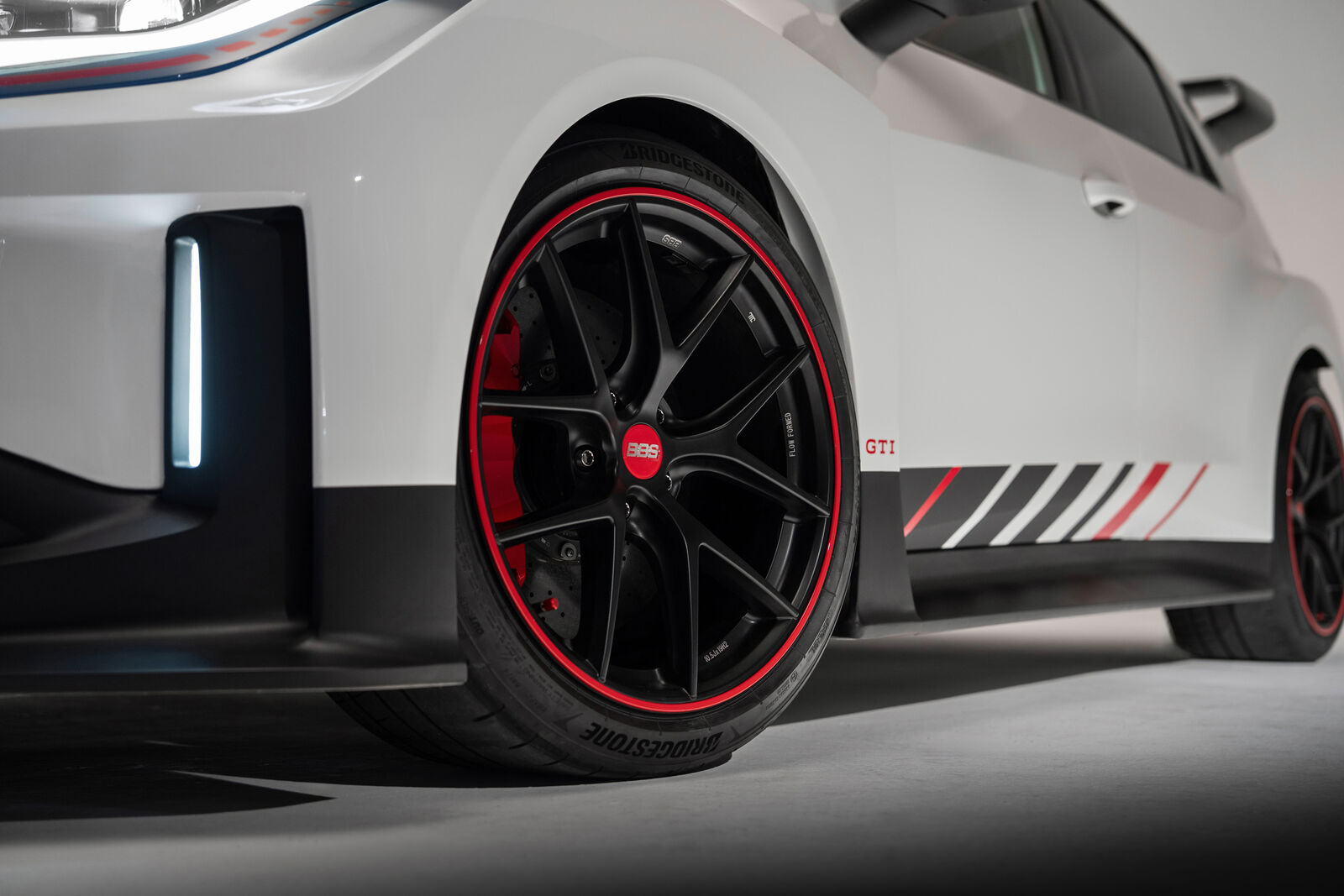
15 millimetres lower than the normal ID. Polo GTI. The concept vehicle and the ID. Polo GTI share the layout of a MacPherson front axle and torsion beam axle. However, the Clubsport is 15 millimetres lower than the production GTI and thus 30 millimetres lower than the normal ID. Polo. The camber, wheel housings, wings and suspension turrets were newly designed, and the steering wheel angle on the front axle was limited to accommodate the significantly wider track widths and broader wheel and tyre combinations. Chassis modifications in detail:
New parametrisation for DCC and front differential lock. Both axles of the ID. Polo GTI Clubsport Concept are coupled to the DCC adaptive chassis control, like on the production vehicle. However, the settings were adjusted for use in the Clubsport and thus for the racetrack. The same applies to the characteristics of the front differential lock. The DCC adaptive chassis control of the ID. Polo GTI Clubsport Concept responds continuously to the road surface and driving situation. The required damping is calculated for each wheel and is adjusted at the shock absorbers of the Clubsport version within fractions of a second. Adaptation of the wheel-specific damping ensures particularly agile and precise handling. The front differential lock – controlled electronically using a multiplate clutch – also has a positive influence of the dynamic driving characteristics of the front-wheel drive vehicle. Compared with purely mechanical locks, it offers advantages such as a variable locking degree. This makes it possible to avoid the kind of negative influences on steering precision that occur with mechanical locks. Traction is significantly increased by the front differential lock. Using a torque vectoring effect, the lock also optimises the handling characteristics of the ID. Polo GTI Clubsport Concept when cornering at high speed. In addition, the new one-box ceramic brake system takes into account the significantly increased driving performance.