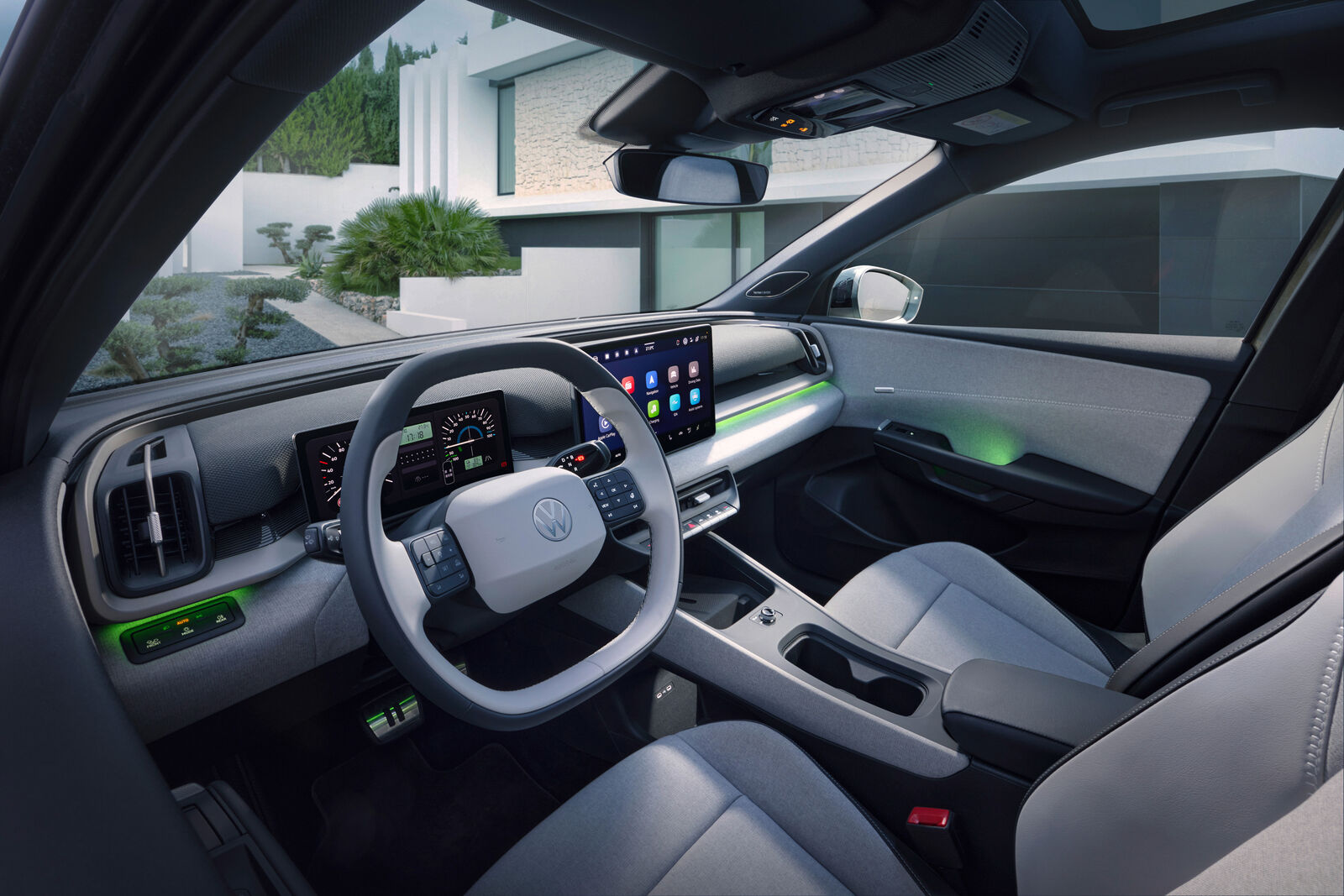
Pure and positive on the inside too. The Volkswagen Pure Positive design language also influences the design of the interior. The incredible clarity, perfection in every detail the high quality of the materials used create an interior that transforms every minute on board into a feel-good experience – whether in the hustle and bustle of the big city or on longer trips. Every functional detail is intuitive and easy to understand, and every physical touchpoint is positioned exactly where you expect it. This clear operating concept creates a familiar Volkswagen environment on board. The warm and friendly interior design embodies the likeability factor. Details such as the fabric-covered dash panel, elegant controls like the tactile, metallic outer edge on the audio controls in the centre console, and the pleasant feel of all buttons, controls, handles and surfaces create an inviting atmosphere. Features such as the interactive ID. Light, which now extends into the doors, or the retro display of the digital instruments inspired by the Golf I (facelift version) add the secret sauce – in this case, technical details that display information in an innovative way or appeal on an emotive level.
Clearly structured cockpit landscape. The ID. Cross has a horizontal dashboard landscape. The Digital Cockpit Pro – the digital instruments – and the infotainment display are arranged on one visual axis. The Digital Cockpit Pro measures 26.0 cm (10.25 inches) across the diagonal and features crystal-clear graphics. If the driver uses the View button on the steering wheel to activate the retro display, a dash of secret sauce is added as the instruments transform into the style of instrument found in the later Golf I models. In this case, there is a classic speedometer on the left and a tachometer on the right. In the ID. Cross, however, it does not show the speed of the engine, but rather the energy output or energy consumption of the drive as a power display. Of course, other modern functions like the Dynamic Road Sign Display have also been integrated into the 1980s-inspired layout. The infotainment system’s touch display, which is located in the centre of the dashboard, measures 32.7 cm (12.9 inches) across the diagonal and is as large as a premium tablet – and the quality of the graphics is just as precise. The display is also easy to reach for the front passenger.
Multifunction steering wheel with classic buttons. The multifunction steering wheel with its clearly arranged button panels has also been redesigned. The cruise control system or, depending on equipment, Adaptive Cruise Control and Travel Assist are combined in the button group to the left of the airbag and horn. This group also contains the volume control. To the right of the airbag is the group of buttons for controlling the Digital Cockpit Pro, activating the voice control and the button for the steering wheel heating (heating function can also be activated later on demand). The steering wheel itself is flattened at the top and bottom (12 and 6 o’clock). The steering column switches for shifting gear and using the parking brake (right) and the turn signal, lighting and wiper functions (left) are located behind the steering wheel in an easily visible and accessible position. The central functions for the headlights and tail light clusters are also located to the left of the dashboard.
Buttons for climate control. The central climate control functions – with temperature control, blower, air conditioning on/off, automatic climate control mode, air recirculation, windscreen defroster, rear window heater – are integrated separately into a strip with buttons in the centre console, while the hazard warning light switch is located in the centre. On the level below, there is the smartphone storage area with an equipment-dependent inductive charging option, two drink holders and the centre armrest with an integrated stowage compartment underneath. Located between the smartphone tray and drink holders is the rotary control for audio functions, which is equally easy to reach for the driver and front passenger. This can be used to adjust the volume and to change songs and stations using the track function. The ID. Light (standard equipment in Style and R-Line) has undergone a major upgrade: for the first time, the interactive and intuitively perceived light strip at the bottom of the windscreen extends not only across the entire width of the dash panel, but now all the way into the front doors. The four buttons for the electric windows and exterior mirror adjustment are realised as a touch panel in the driver door. Attention to detail is not only reflected in the intuitive operability of all elements and the quality of the materials, but also by equipment-dependent refinements such as the elegant decorative seams in the door trim and the integration of small Volkswagen badges (R-Line badges in the sporty flagship model) to finish off these seams.
Quality without class limits. The new ID. Cross is also characterised by a quality of interior that is equivalent to the next class up. This impression is reinforced by details such as the robust and ergonomic door openers from the T-Roc, the fabric-covered dash panel surface, optional features such as a high-end sound system from Harman Kardon and the 12-way electrically adjustable front seats with massage function, available in an SUV in this class for the first time. The space available in the rear also eliminates class boundaries. The same goes for the five-seater’s 475-litre luggage compartment. Built into the area under the variable luggage compartment floor is an XL storage area for transporting shopping bags, for example. Just as practical is the 25-litre extra luggage compartment (frunk) under the bonnet, which can be used to store charging cables, for example.