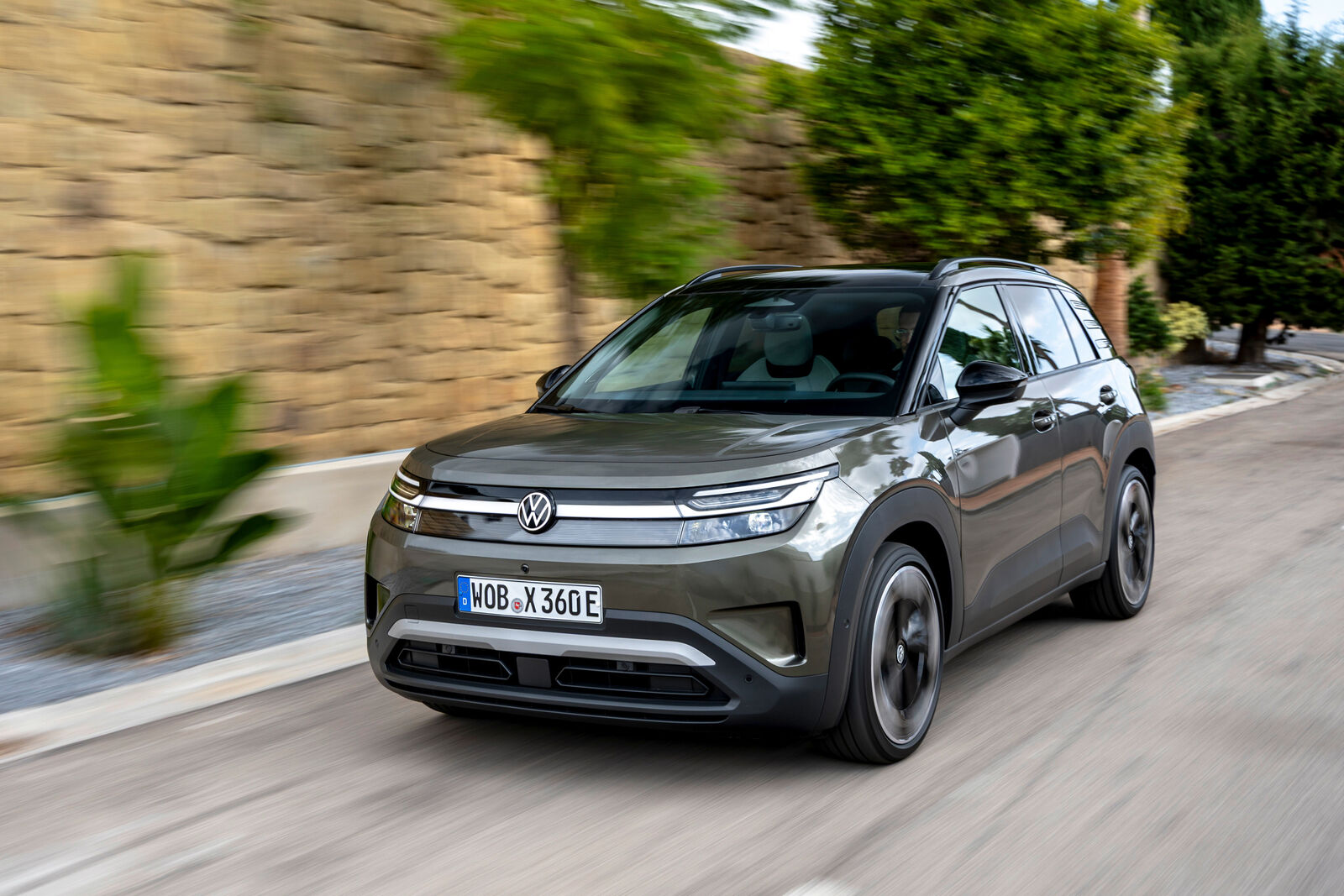
Electric front-wheel drive. The electric drive of the ID. Cross – the APP290 – is a completely new development. APP stands for the axial parallel position of the permanently excited synchronous motor, while 290 indicates the maximum torque achievable with this drive motor in newton-metres. The motor is compact and very light at 75 kg, which has a positive effect on consumption, agility and space. With its high efficiency, it also offers a further advantage in terms of consumption and constant power development over a wide rpm range (good response at all motor and driving speeds, greater comfort). A one-speed gearbox with integrated power and control electronics is flanged onto the motor housing. This coordinates the power and torque development as well as the recuperation of the drive system. These power electronics also convert the direct current (DC) stored in the battery into the alternating current (AC) needed by the electric drive motor. Other components of the drive system, which is integrated compactly in the front end, include the AC and DC charging socket at the front on the right-hand side of the ID. Cross, the charger integrated nearby and the electric air conditioning compressor.
DC charging with up to 105 kW. The two batteries available for the ID. Cross are also new developments. These batteries are known as Group unified cells and are developed in cooperation with the Volkswagen subsidiary PowerCo. The battery system uses cell-to-pack technology, where the cells are combined directly into a battery pack without the intermediate step via module housings. Three of these battery packs form the energy storage unit. At the same time, the battery housing performs a load-bearing function within the body structure. The 37 kWh battery is a lithium-ferrophosphate version (LFP), while the 52 kWh version is a nickel-manganese-cobalt variant (NMC) with an even higher energy density. Under optimal conditions, the 37 kWh battery can be charged from 10 to 80 per cent at 88 kW in approx. 23 minutes at a DC quick-charging station. The 52 kW battery can be charged from 10 to 80 per cent in approx. 24 minutes with a maximum charging capacity of 105 kW. The AC charging capacity is up to 11 kW in each case.
Optional heat pump. To increase the range at low outside temperatures, Volkswagen offers a heat pump as optional equipment for the ID. Cross. This compresses a refrigerant under high pressure and thus generates heat. It is used to heat cold air inside the vehicle, so the interior heater needs to draw less energy from the high-voltage battery.
Five driving profiles. The driver can influence power delivery and consumption using the driving profiles. Eco, Comfort, Sport and Individual profiles are available initially in all equipment versions. Eco supports the driver in adopting a consumption-efficient driving style. In this case, the ID. Cross accelerates slightly more gently; the output of both the drive system and the air conditioning settings is also reduced. Comfort is the standard driving profile designed for the best possible comfort. Sport focuses on maximum dynamic performance for the drive and steering. The Individual driving profile allows the driver to set up the SUV individually in terms of steering, drive system, driving sound, ACC (standard equipment in the Life specification and above, can be activated subsequently in Trend), light assistance and air conditioning. As a special feature, the ID. Cross R-Line with 166 kW is the only version that also offers the Traction driving profile. Here, the electronically controlled front differential lock used exclusively in the ID. Cross R-Line ensures a particularly high level of traction on wet and wintry roads.