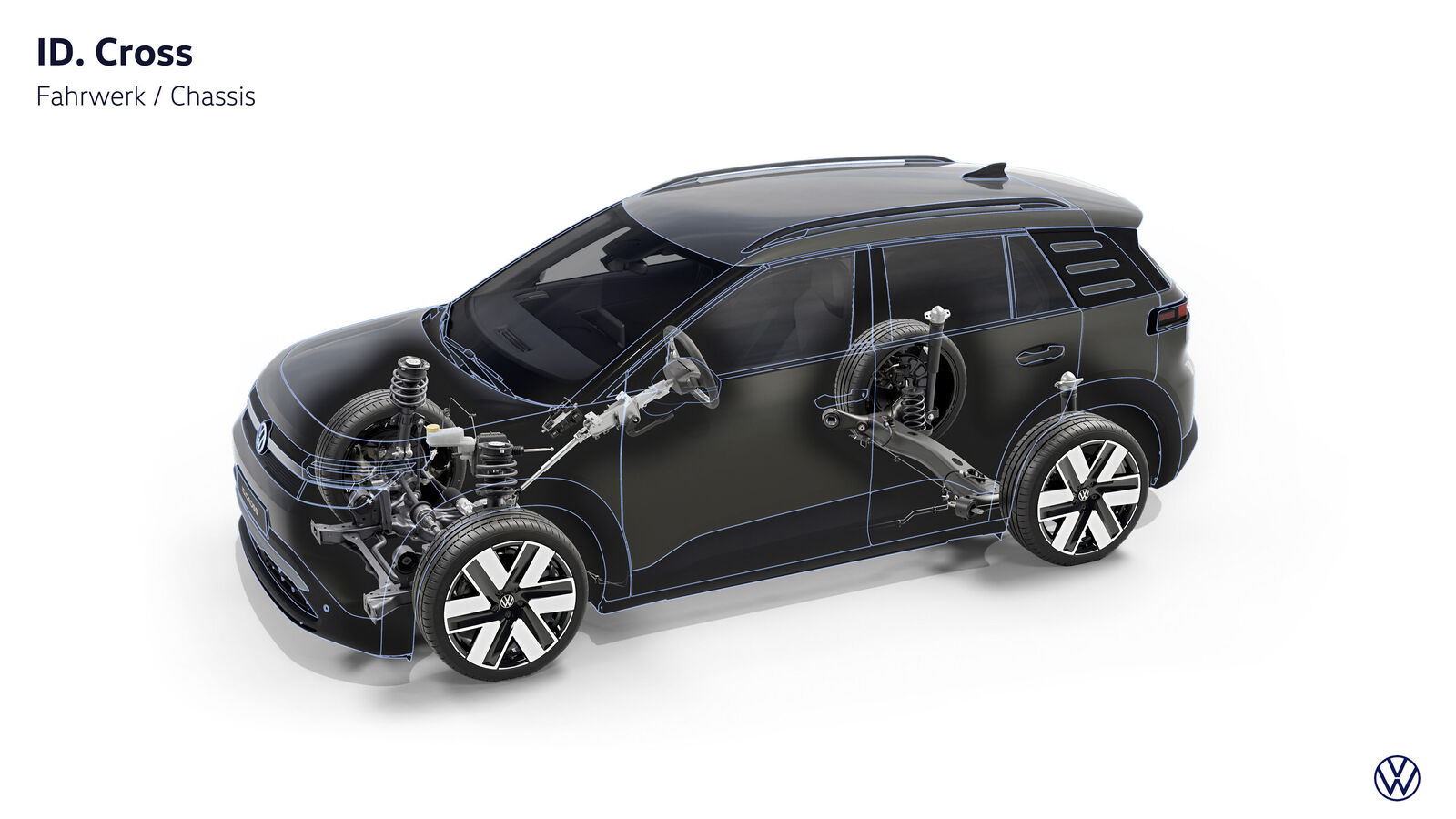
New axle architecture. The chassis has also been adapted to the new front-wheel drive of the electric SUV: a MacPherson front axle is combined with a particularly compact torsion beam rear axle. The interaction between these two new axles is characterised by maximum-precision linearity – resulting in vehicle handling that conveys maximum feedback to the driver and thus ensures noticeably more safety. In addition, the ID. Cross features particularly good ride comfort. A new one-box brake system with disc brakes on the front and rear axles has also perfected the controllability of the brakes and the pedal feel compared to other electric vehicles. The brake system is particularly light and offers very efficient recuperation. The axles of the ID. Cross R-Line were modified and thus adapted to the even higher power level and the combination with the front differential lock installed here.
McPherson front axle. At the front, the Volkswagen SUV uses MacPherson suspension struts. The axle has a very compact design. The premium shock absorbers with their generously dimensioned pistons and innovative control of compression stage forces have a positive effect on comfort and handling characteristics. Specific suspension strut mountings optimise both ride comfort and spring response. The handling characteristics are also refined thanks to a comparatively rigid connection of the stabiliser. Overall, the front axle produces very precise steering and handling characteristics.
Torsion beam rear axle. The lightweight rear axle has been specifically adapted to the combination with an electric front-wheel drive. A host of different measures optimise comfort and ride characteristics. For example, bonded rubber pads on the coil springs improve comfort and acoustics. A passive damper weight significantly reduces low-frequency rolling noise in the interior. Inclined axle locating mounts with innovative two-component technology also reduce noise and vibrations and ensure improved axle guidance, increasing driving safety. Last but not least, the torsion beam rear axle is very compact, allowing a large load capacity.
Front differential lock and DCC in the ID. Cross R-Line with 166 kW. The 166 kW version of the ID. Cross R-Line occupies a special position in the range of the new electric SUV model product line: it is equipped as standard and exclusively with an electronically controlled front differential lock. Also standard: DCC adaptive chassis control with 15 millimetre lowering and progressive steering. Thanks to its progressive ratio, the latter offers additional steering precision and steering agility; at low speeds, it makes manoeuvring easier.
Front differential lock in detail. The front differential lock deserves special attention, as its control is linked to the new Traction driving profile for the first time. This profile is available in the ID. Cross R-Line with 166 kW in addition to the Eco, Comfort, Sport and Individual profiles. If the driver activates the profile, the following message appears on the infotainment display:
“The Traction driving profile provides greater comfort and safety, particularly on surfaces with varying levels of grip or slippery road surfaces. The traction control system enables smooth moving off and acceleration across the entire speed range without wheel spin.”
And this can be taken literally. This is because the front differential lock on board the ID. Cross R-Line is more than just a traction aid. Depending on the driving situation and profile, it can be selectively engaged by a multiplate clutch. This means that the front differential lock not only improves traction when accelerating out of bends – it also influences driving stability, steering behaviour and steering feel. And this does not just apply in the limit range. Instead, the setup in the ID. Cross R-Line has been designed so that slightly engaging the multiplate clutch gives the steering a more substantial feel and makes the vehicle's handling more stable, both when driving in a straight line and when changing lanes. When accelerating out of bends, there is also a stabilising torque vectoring effect. The lock is particularly useful when there are different friction coefficients between the left and right front wheels, for example, when one wheel is driving on grippy tarmac and the other on snow, or when there is slight axle articulation off-road. The lock ensures that the maximum grip potential is transferred to the road.
DCC in detail. The DCC chassis control system, on board as standard in the ID. Cross R-Line with 166 kW and optional in the ID. Cross Style from 155 kW, reacts continuously to the road surface and driving situation. The chassis can be individually configured by the driver using the set driving profile – Eco, Comfort, Sport, Individual and Traction (R-Line only). The spectrum here ranges from a comfort-oriented setup to a dynamic configuration designed for maximum traction. In each of the driving profiles, the required damping is calculated for each wheel in fractions of a second and adjusted at the shock absorbers. Adjustment of the wheel-specific damping ensures agile and precise handling.
Vehicle Dynamics Manager. The chassis systems are centrally coordinated by a Vehicle Dynamics Manager. This ensures that assembly groups such as the DCC, front differential lock, brake system including ESC and XDS and the progressive steering do not work independently from each other but are closely integrated.